Delivery Challan Explained: When You Need One and How It Differs From an Invoice
By FreeBillKit Team · June 26, 2026 · Updated July 30, 2026
A delivery challan is the document that travels with goods when they move without a sale happening yet: a stock transfer between your own branches, material sent out for job work, or products going to a buyer “on approval.” It records what left your premises and in what quantity, but unlike an invoice it never asks for payment.
In the US, UK, Canada and Australia this document is usually called a delivery note (also a dispatch note or packing slip). It is the same thing: a list of the goods sent with a shipment, kept separate from the invoice.
Picture a fairly ordinary Tuesday. A batch of goods has to leave your warehouse this afternoon. Maybe finished stock heading to your second outlet, maybe raw material going to a workshop for polishing. The driver is already at the gate. And yet you can’t raise an invoice, because nothing has actually been sold. Money isn’t changing hands. So what do you put in the driver’s hand so the shipment is properly documented and doesn’t get flagged in transit?
That small, awkward gap is the entire reason the delivery challan exists. It’s one of those documents nobody teaches you about until the day you suddenly need one, usually under time pressure.
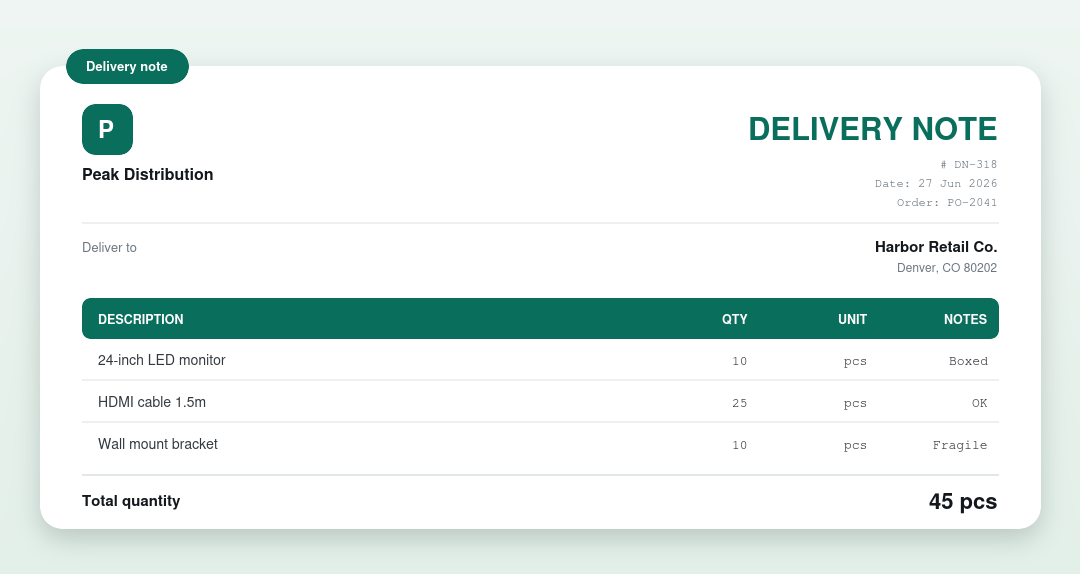
What a delivery challan actually is
Strip away the jargon and it’s a movement note. It says: these specific items, in these quantities, left this place, on this date, headed there. It proves the goods are accounted for while they’re on the road, and it gives the person receiving them something to check the delivery against.
The key word is movement, not sale. An invoice is a demand for payment tied to a transaction. A challan is a record of physical movement that may, or may not, turn into a sale later. That single distinction explains almost everything else about how the two documents behave.
When you actually need one
You reach for a delivery challan whenever goods physically move but the sale either hasn’t happened or might never happen. The common cases:
- Stock transfers: shifting inventory between your own locations. You’re not selling anything to yourself, so an invoice would be wrong.
- Job work: sending material to a third party for processing (cutting, printing, assembly, finishing) and getting it back. The goods leave, but ownership doesn’t.
- Goods on approval: sending samples or products a customer can return if they don’t buy. The sale only crystallises if they keep the items.
- Exhibitions and demos: moving stock to a trade show or a client site temporarily.
- Quantity not yet known: situations like supplying gas or bulk material where the exact billable amount is confirmed only after delivery.
If you’re unsure which way to lean, ask one question: has a sale been completed at the moment the goods leave? If the honest answer is “no” or “not yet,” a challan is almost certainly the right call.
Delivery challan vs invoice: the difference that trips people up
This is where most of the confusion lives, so it’s worth being blunt about it. The two documents look similar: both list items, quantities and parties, but they do opposite jobs.
A useful mental shortcut: the invoice is about money, the challan is about movement. If you later need to bill for goods that went out on a challan, you raise a separate invoice referencing it. And if you regularly confuse the two, our breakdown of the proforma vs commercial invoice distinction is worth a read too, since the same “which document when” logic applies across all of them.
What belongs on a delivery challan
There’s no need to overcomplicate it, but a challan that’s missing key fields can hold up a shipment or fail an inspection. At minimum, make sure yours carries:
- A unique serial number and the date of issue
- Your business name, address and tax registration details
- The consignee’s name and delivery address
- A clear description of the goods, with quantity (and HSN code where tax rules require it)
- The reason for movement: job work, stock transfer, approval, and so on
- Vehicle or transport details, where relevant
- Signatures from the sender and a space for the receiver to acknowledge
Notice what’s usually absent: a payment total. Some challans show the value of goods for transport or insurance purposes, but they don’t bill the recipient. If you find yourself adding payment terms and a “balance due,” pause. You probably want an invoice instead, and our free invoice generator will get you there faster.
The main types you’ll come across
People talk about “types” of challan, but really they’re just named after the reason for movement:
- Job work challan: goods sent for processing and expected back.
- Stock transfer challan: inventory moving between your own branches or warehouses.
- Sale-or-return (approval) challan: goods a customer can keep or send back.
- Line sales challan: used when goods are loaded onto a vehicle and sold along a route, with the final billed quantity confirmed at the end.
The format barely changes between them. What changes is the “reason for transport” field, which matters more than people expect because it’s the first thing a tax officer or auditor looks at.
Where the e-way bill fits in
In several countries, India being the obvious example, once the value of goods in transit crosses a threshold, you also need an electronic waybill (e-way bill) alongside the challan. The challan describes what is moving and why; the e-way bill is the tax authority’s digital permission slip for that movement. They work together, not as substitutes. If your shipments are large or cross state lines, build the habit of checking the e-way bill rule before the vehicle leaves, not after it’s been stopped.
Turning a challan into an invoice
Here’s the step people forget. When goods that went out on a challan are accepted: the approval becomes a sale, the job work returns and gets billed, the branch confirms receipt. That movement now needs to show up in your accounts as revenue. The clean way to handle it is to raise an invoice that references the original challan number, so anyone following the trail can move from “goods left” to “money owed” without guessing. Keep the line items consistent between the two; if the challan said twelve units, the invoice shouldn’t quietly say ten. Treat the challan and the invoice as two halves of one story, and month-end reconciliation stops being a headache.
Mistakes that cause problems later
A few patterns come up again and again, and all of them are avoidable:
- Reusing or skipping serial numbers. Gaps and duplicates are the fastest way to lose an auditor’s trust. Keep the sequence clean and continuous.
- Vague descriptions. “Assorted items” helps no one. Be specific enough that the receiver can tick off each line.
- Forgetting to convert to an invoice. When goods on approval get accepted, the sale needs to be billed. A challan that never becomes an invoice is revenue that never gets recorded.
- No acknowledgement copy. Without a signed receiver copy, you have no proof the goods actually arrived, which matters the day something goes missing.
Skip the spreadsheet. Our free Delivery Challan Generator lays out every field above, lets you add items and quantities, and downloads a clean PDF, no signup, no watermark.
Once you’ve got the rhythm, challan for movement and invoice for money, the rest is just good habits. And if a shipment is genuinely a sale heading abroad rather than a transfer, you’ll want a commercial invoice or a proforma invoice instead. Pick the document that matches what’s really happening to the goods, and the paperwork stops being stressful.
Delivery note vs invoice
| Delivery note | Invoice | |
|---|---|---|
| Purpose | Lists goods delivered | Requests payment |
| Shows prices | Optional | Yes |
| Requests payment | No | Yes |
| When issued | With the goods | After or with the sale |
| Also called | Delivery challan | Bill, sales invoice |
Frequently asked questions
Is a delivery challan the same as an invoice?
No. A delivery challan records the movement of goods and doesn’t request payment. An invoice records a completed sale and asks the buyer to pay. You can issue a challan first and an invoice later for the same goods.
Can I issue a delivery challan without an invoice?
Yes. That’s the whole point of it. When goods move without a sale (stock transfers, job work, goods on approval), a challan is the correct document and no invoice exists yet.
Does a delivery challan need to show the price of goods?
Not necessarily. Many challans show quantity only. Some include the value of goods for transport or insurance, but they still don’t bill the recipient. If you’re charging for the goods, raise an invoice instead.
How many copies of a delivery challan should I make?
Typically three: one for the recipient, one to travel with the transporter, and one kept by you. The exact number can depend on local tax rules, but always keep a signed copy for your own records.
Do I still need an e-way bill if I have a delivery challan?
In many places, yes. Once the value of goods in transit crosses a set threshold, an e-way bill is required in addition to the challan. The two documents serve different purposes and aren’t interchangeable.
n