Commercial Invoice for Exports: What to Include and the Mistakes That Get Shipments Stuck
By FreeBillKit Team · July 2, 2026 · Updated July 30, 2026
A commercial invoice is the main customs document for an international shipment. It declares what’s being shipped, what it’s worth, and the terms of sale, so customs can assess duties and clear the goods. Get the HS codes, Incoterms, and declared value right and your shipment moves; get them wrong and it sits in a bonded warehouse while someone emails you.
Domestic invoicing is forgiving. Send goods across a border and the same casual approach gets your shipment held, your customer charged surprise duties, and your delivery date blown. The document standing between “cleared” and “stuck” is the commercial invoice, and customs officers read it far more literally than your regular clients ever read an invoice.
If you’re shipping internationally for the first time, or your shipments keep getting flagged, this is the document to get right.
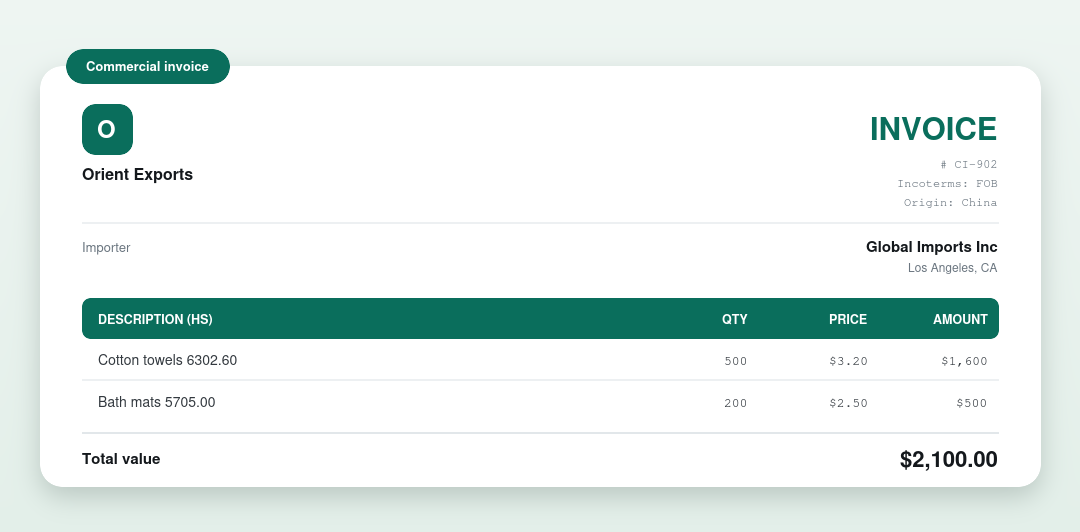
What a commercial invoice is (and how it differs from a normal one)
A standard invoice exists to get you paid. A commercial invoice does that too, but its primary reader isn’t your customer. It’s customs. It’s the legal declaration of a cross-border sale, and authorities on both ends use it to decide what duties and taxes apply and whether the goods are allowed in at all.
So while a domestic invoice can be fairly relaxed about detail, a commercial invoice has to be precise about things a normal invoice never mentions: the country of origin, the harmonised codes for each product, who’s responsible for shipping costs and risk, and an honest declared value.
Why customs needs it
Picture the officer’s side of the desk. They have a box and a piece of paper, and they need to answer three questions fast: what is this, what is it worth, and who pays the duty? The commercial invoice answers all three. When it’s clear and consistent, clearance is routine. When a code is missing or the value looks off, the shipment gets pulled for inspection, and that delay is almost always on you, not the carrier.
What a commercial invoice must include
A few of these deserve a closer look:
- HS / HTS codes. Every product has a harmonised system code that tells customs exactly what it is and what duty rate applies. Guessing here is how shipments get reclassified and delayed.
- Incoterms. These standard three-letter terms (EXW, FOB, CIF, DDP and so on) define exactly where your responsibility ends and the buyer’s begins: who pays freight, who pays duty, who carries the risk if it’s damaged in transit. Naming the wrong one creates expensive surprises.
- Declared value. Be accurate. Under-declaring to save the buyer duty is a customs offence, not a favour.
- Country of origin. Where the goods were made, which drives trade-agreement duty rates.
Commercial invoice vs proforma invoice
These two travel together in export work and get mixed up constantly. A proforma invoice is sent before the sale is final, a detailed quote the buyer can use to arrange payment, open a letter of credit, or apply for an import licence. The commercial invoice is the real thing, issued once the sale is committed and the goods ship. We pull the two apart fully in proforma vs commercial invoice, which is worth a read if you’re ever unsure which one a buyer is asking for.
How it differs from a packing list and a delivery note
A commercial invoice states value and terms; a packing list states what’s physically in each box (weights, dimensions, carton counts) without prices. Customs may want both. And for goods moving without a sale at all, such as samples or stock transfers, you’d reach for a delivery challan instead, since there’s no commercial value being billed. Matching the document to the nature of the movement is half the battle.
Mistakes that get shipments stuck
- Wrong or missing HS codes. The single most common cause of customs delays. Look them up properly per product.
- No Incoterm stated. Leaves duty and freight responsibility ambiguous, which invites disputes and held parcels.
- Vague descriptions. “Gifts” or “samples” with no detail is a red flag. Describe the actual goods.
- Inconsistent values. If the invoice, the packing list and the customs declaration disagree on value, expect an inspection.
- Under-declaring value. Tempting, illegal, and not worth the penalties.
Build a customs-ready document with our free Commercial Invoice Generator: fields for HS codes, Incoterms, country of origin and declared value, downloaded as a clean PDF. No signup.
The goods that clear fastest are the boring ones: accurate codes, a stated Incoterm, an honest value, and descriptions a stranger could verify. Treat the commercial invoice as a declaration rather than a bill, fill it in like an officer will read every line, and your shipments stop getting stuck.
Incoterms in plain English
Incoterms look intimidating, a wall of acronyms, but you only need to recognise a handful. They all answer one question: at what point do cost and risk pass from you to the buyer?
- EXW (Ex Works): the buyer takes over the moment goods leave your door. Cheapest for you, most work for them.
- FOB (Free On Board): you’re responsible until the goods are loaded onto the ship; after that it’s the buyer’s.
- CIF (Cost, Insurance, Freight): you cover shipping and insurance to the destination port, then hand off.
- DDP (Delivered Duty Paid): you handle everything, duties included, to the buyer’s door. Easiest for them, most exposure for you.
Choose the term deliberately and write it on the invoice. The classic mistake is a seller quietly assuming FOB while the buyer assumes DDP. Then a duty bill arrives and nobody wants to pay it. Stating the Incoterm ends that argument before it starts.
A 60-second pre-ship checklist
Before any international parcel leaves, run through this:
- Every line has an HS code that actually matches the product.
- The declared value is honest and matches your other documents.
- One clear Incoterm is stated.
- Country of origin is shown.
- Descriptions are specific: a stranger could identify the goods from them.
- Exporter and importer details, including tax IDs, are complete.
Tick all six and your shipment sits in the “boring, clears fast” category, exactly where you want it.
Who fills it in, you or your courier?
If you ship through a courier or freight forwarder, they’ll often generate a commercial invoice from the details you provide, but accuracy is still your responsibility as the exporter. Treat their form as a convenience, not a get-out. It’s worth preparing your own clean version so you control exactly what’s declared, then matching the courier’s paperwork to yours rather than the other way round.
It also pays to keep a copy of every commercial invoice you file. Customs queries can surface weeks after a shipment has cleared, and being able to produce the exact declaration: codes, value, terms and all, turns a potential headache into a two-minute reply. Treat the filed invoice as part of your business records, not a throwaway shipping form.
Commercial invoice: the fields customs needs
| Field | Why customs needs it |
|---|---|
| Exporter & importer | Identifies the parties to the shipment |
| Goods description + HS codes | Classifies the goods and sets the duty rate |
| Quantity & unit price | Supports the declared value |
| Total declared value | The basis for assessing duty and taxes |
| Incoterms | Shows who pays freight, insurance and duty |
| Country of origin | Affects duty and trade-agreement eligibility |
| Signed declaration | Confirms the details are true and accurate |
Frequently asked questions
What is a commercial invoice used for?
It’s the primary customs document for an international shipment. Customs authorities use it to identify the goods, assess duties and taxes, and decide whether to clear the shipment. It also serves as the seller’s request for payment.
What’s the difference between a commercial invoice and a proforma invoice?
A proforma invoice is sent before the sale is finalised, as a detailed quote. A commercial invoice is the real document issued once the sale is committed and the goods ship. Customs clears against the commercial invoice.
Do I need HS codes on a commercial invoice?
For most international shipments, yes. The HS (harmonised system) code identifies each product so customs can apply the correct duty rate. Missing or wrong codes are a leading cause of clearance delays.
What are Incoterms and why do they matter?
Incoterms are standard three-letter terms (like FOB, CIF, DDP) that define who pays for freight, duties, and insurance, and where risk passes from seller to buyer. Stating the right one prevents costly disputes.
Can I under-declare the value to reduce duties?
No. Declaring a value lower than the true sale price is a customs offence that can lead to fines, seizure, and future scrutiny. Always declare the accurate value.
n