What Is a Credit Note and When Should You Issue One?
By FreeBillKit Team · July 1, 2026 · Updated July 30, 2026
A credit note is a document a seller issues to reduce or cancel an amount a buyer owes on an invoice that’s already been sent. You raise one for returns, overcharges, cancellations, or a discount agreed after invoicing. It adjusts the books properly, without deleting the original invoice, which you should never do.
Something’s gone slightly wrong with an invoice you already sent. Maybe the client returned half the order, maybe you fat-fingered a price, maybe you promised a goodwill discount after the fact. The instinct is to just edit the invoice or delete it and start again. Resist that instinct. It’s exactly the move that turns a small correction into a messy audit problem. The clean fix is a credit note.
It’s one of those documents that sounds more formal than it is. Once you see what it’s for, it becomes the obvious tool for tidying up after an invoice has left the building.
What a credit note actually is
A credit note, sometimes called a credit memo, records money the seller owes back to the buyer, or an amount the buyer no longer has to pay. It points back to the original invoice and reduces it by a stated amount. If you invoiced £1,000 and the client returned £200 of goods, a £200 credit note brings the real balance owed down to £800, with a clean record of why.
The original invoice stays exactly as it was. The credit note sits alongside it as the correction. Together they tell the true story.
Why you don’t just edit or delete the invoice
This is the part worth internalising. Invoices are sequentially numbered for a reason: that unbroken sequence is what auditors and tax authorities trust. The moment you delete invoice #1043 or quietly change its total, you’ve created a gap or an inconsistency that looks, at best, careless and, at worst, like you’re hiding something.
A credit note solves this without touching the original. It’s its own numbered document that references the invoice it corrects, so the trail reads cleanly: here’s what we billed, here’s the adjustment, here’s why. The same principle underpins the difference between an invoice and a receipt: each document has one job, and you don’t blur them.
When to issue a credit note
The common triggers, all of them after an invoice has already gone out:
- Returned or rejected goods. The customer sends part or all of the order back.
- An overcharge. Wrong price, wrong quantity, a tax slip. You billed more than you should have.
- A cancelled order. The invoice went out, then the deal fell through.
- A post-invoice discount. You agreed to knock something off after the fact, perhaps for a delay or as goodwill.
- Damaged or faulty items. The goods arrived, but not in a state the customer should pay full price for.
If the correction needs to happen before the invoice is sent, you don’t need a credit note at all. Just fix the draft. The credit note is specifically for after the invoice is already in the client’s hands.
Credit note vs refund vs debit note
These three get tangled, so here’s the quick untangling. A credit note reduces what’s owed. It’s a paperwork adjustment. A refund is the actual money moving back to the customer; a credit note often accompanies a refund, but it can also just sit as credit against a future order. A debit note runs the other direction. It’s typically raised by the buyer to flag that they’re returning goods and expect a credit, or by a seller to charge more. For most small businesses, the credit note is the one you’ll reach for regularly.
What belongs on a credit note
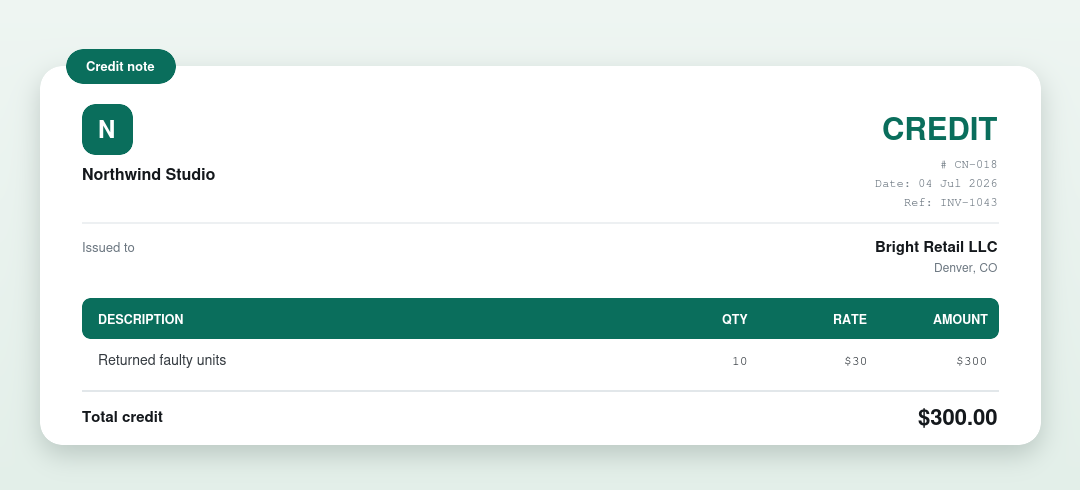
- A unique credit note number and the issue date
- A clear label so it can’t be mistaken for an invoice
- Your details and the customer’s details
- The original invoice number it relates to
- The items or amounts being credited, with the reason
- Any tax adjustment and the total credit
That reference to the original invoice is the most important line. Without it, the credit note floats free and the match back to the original bill is lost.
How it affects your accounts and tax
A credit note reverses revenue you previously recorded, and it usually reverses the tax on that portion too. If you charged VAT or sales tax on the original invoice and then credit part of it back, the tax follows the credit. Keeping credit notes properly numbered and linked means your reported income and tax stay accurate, which is the whole point of doing this the clean way rather than editing invoices after the fact.
Common mistakes
- Editing the original invoice instead. Breaks your audit trail. Always issue a separate credit note.
- Forgetting the invoice reference. A credit note that doesn’t name the invoice it corrects is hard to reconcile later.
- Ignoring the tax adjustment. If you credit the goods but not the tax, your tax records drift out of line.
- Reusing invoice numbering. Credit notes need their own sequence, separate from invoices.
Create a properly labelled, numbered credit note linked to the original invoice with our free Credit Note Generator: fill it in, download the PDF, done. No signup.
Treat the credit note as the grown-up way to say “that figure needs adjusting.” It keeps your numbering honest, your tax accurate, and your client’s records matching yours. The next time anyone audits either side, that is exactly what you want. The same discipline applies if you trade internationally and need to adjust a commercial invoice after shipping.
A worked example
You invoice a retailer £1,200 for 40 units at £30 each. A week later they return 10 faulty units. You don’t touch the original invoice. It correctly recorded what you billed at the time. Instead you raise credit note CN-018, referencing invoice INV-1043, for 10 units at £30 (£300) plus the tax on that £300. Your books now show £1,200 invoiced and £300 credited, a true balance of £900, and an auditor can follow every step. If the retailer had already paid in full, that £300 is either refunded or held as credit against their next order. Your call, but the credit note documents it either way.
Credit note vs cancelling an invoice
People sometimes ask why they can’t just “cancel” an invoice. In practice, cancelling cleanly is issuing a credit note, one that credits the entire amount. The original invoice still exists in your sequence, so there’s no suspicious gap, and the full credit note neutralises it. That’s the compliant way to undo an invoice you shouldn’t have sent, whether the order fell through or you billed the wrong client.
Keeping credit notes organised
Give credit notes their own numbering sequence (CN-001, CN-002…) separate from invoices, and store each one next to the invoice it corrects. When tax season arrives, that pairing is what makes your reported income defensible in about thirty seconds rather than thirty minutes of detective work.
One practical habit: issue the credit note promptly, while the reason is fresh and the customer is expecting it. A credit note that turns up weeks after a return makes people wonder what else slipped, and it leaves your books overstating income in the meantime. Same day or next day is the standard to aim for, and it keeps the customer relationship as clean as the paperwork.
Credit note vs debit note vs refund
| Credit note | Debit note | Refund | |
|---|---|---|---|
| Issued by | Seller | Buyer | Seller |
| Effect | Reduces what the buyer owes | Requests an extra amount | Returns actual money |
| Money moves | Not necessarily | Not necessarily | Yes |
| Typical use | Returns, overcharge, discount | Undercharge, extra goods | Paying the customer back |
Frequently asked questions
What is a credit note used for?
To reduce or cancel an amount a customer owes on an invoice that’s already been issued: for returns, overcharges, cancellations, or post-invoice discounts. It corrects the balance without deleting the original invoice.
Can I just delete or edit the original invoice instead?
You shouldn’t. Invoices are sequentially numbered, and deleting or altering one breaks the audit trail that tax authorities rely on. Issuing a separate credit note keeps your records clean and traceable.
Is a credit note the same as a refund?
No. A credit note is a document that reduces what’s owed. A refund is the actual return of money. A credit note often accompanies a refund, but it can also be held as credit against the customer’s next order.
Does a credit note reverse the tax too?
Usually, yes. If you charged VAT or sales tax on the original invoice, crediting part of it back also reverses the tax on that portion, keeping your tax records accurate.
What information must a credit note include?
A unique credit note number, the issue date, your and the customer’s details, the original invoice number, the items or amounts being credited with the reason, and any tax adjustment.
n