Invoice vs Receipt: What’s the Difference (and When to Use Each)
By FreeBillKit Team · June 16, 2026 · Updated August 12, 2026
An invoice requests payment before it’s made; a receipt confirms payment after it lands. You send an invoice to ask a client to pay, then issue a receipt once the money is in. Same transaction, two documents, opposite ends of it.
People mix these up all the time. A client asks for “the invoice” when they mean proof they already paid, or a supplier sends a “receipt” that’s really a bill. Anchor the difference to one thing, timing, and it stops being confusing.
What is an invoice?
An invoice is a request for payment. It lists what you delivered, how much is owed and the deadline to pay, so it carries an invoice number, an issue date, a due date and your payment details. You’ll also hear it called a bill or a sales invoice; before a sale is final, the equivalent is a proforma invoice.
What is a receipt?
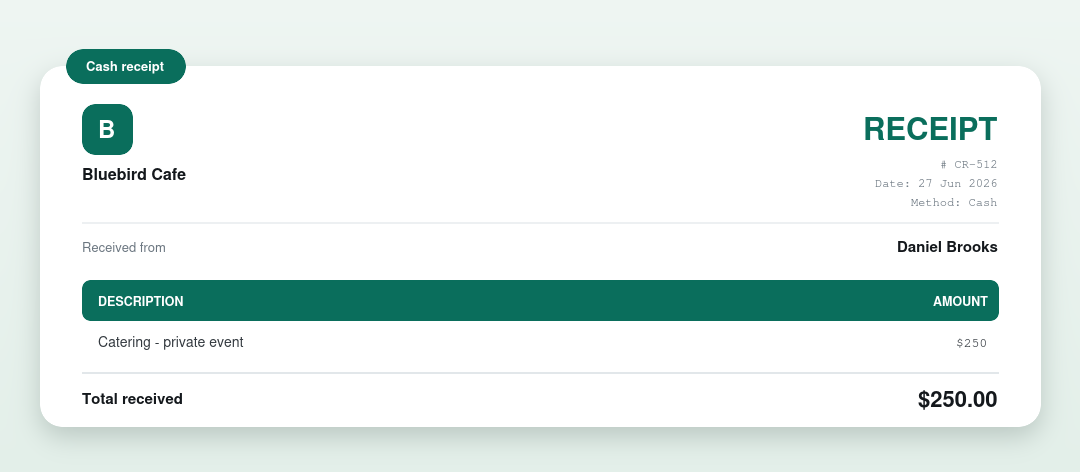
A receipt is proof that a payment was made. It records who paid, how much, when and what for. It doesn’t ask for anything. It confirms the money changed hands. A cash receipt, a card slip and a rent receipt are all receipts.
Invoice vs receipt, side by side
| Invoice | Receipt | |
|---|---|---|
| Purpose | Requests payment | Confirms payment |
| When it’s issued | Before payment | After payment |
| What it shows | Amount due | Amount paid |
| Money has moved? | No, still owed | Yes, received |
| Typical trigger | Work delivered or order placed | Money received |
| Accounting role | Accounts receivable | Proof of payment |
When you send an invoice
Any time you’ve done the work or shipped the goods and want to be paid. The invoice sets out what you delivered, the amount and the deadline. It’s the document that starts the payment clock, which is why the due date and your payment details live on it. New to it? See how to write an invoice.
When you issue a receipt
The moment the payment arrives, especially with cash. Card and bank transfers leave their own trail, but a receipt is still the cleanest acknowledgement, and for cash it’s often the only record the payment happened at all. It reassures the payer and keeps your books straight.
A quick example
You finish a $600 design job. You email an invoice for $600 on Net 15 terms. Two weeks later the client pays by bank transfer, so you send a receipt for $600 marked paid. The invoice asked; the receipt confirmed. Same $600, two documents.
Do you need both?
For most sales, yes. The invoice gets you paid; the receipt closes the loop. Plenty of small businesses skip the receipt on card payments and lean on the bank statement, which is fine, until a customer asks “can I get a receipt for that?” and you want to hand one over without fuss.
Mistakes worth avoiding
- Labelling a receipt as an invoice, or the reverse: it confuses the client and your accountant.
- Treating a paid invoice as a receipt. Marking it “paid” works in a pinch, but a proper receipt is cleaner.
- Forgetting the receipt on cash deals, then having no proof a month later.
Make both, free
Create an invoice to get paid, then a receipt once the money lands. Both download as clean PDFs, no signup. Want to see one first? Here’s an invoice example and a receipt example.
Frequently asked questions
Is an invoice a receipt?
No. An invoice asks for money that has not been paid yet. A receipt confirms money that has already arrived. Sending an invoice after payment, or a receipt before it, is the most common mix-up between the two.
Is an invoice the same as a receipt?
No. An invoice requests payment before it’s paid; a receipt confirms payment after. They sit at opposite ends of the same transaction.
Does a paid invoice count as a receipt?
It can serve as informal proof if you mark it “paid”, but a proper receipt is clearer for both sides and tidier for your records.
Which comes first, the invoice or the receipt?
The invoice, while payment is still owed. The receipt follows once you’ve been paid.
Do I need a receipt for card or bank payments?
The statement is a record, but a receipt is the cleanest acknowledgement, and expected the moment a customer asks for one.
Written by the FreeBillKit team. Last reviewed July 2026.