Painting Invoice Template
A painting invoice bills prep work separately from painting, states the number of coats, and lists paint by product and gallons. Charge by room, by square foot or by the hour, but say which. Interior and exterior work should not share a line. Build one free below, no signup or watermark.
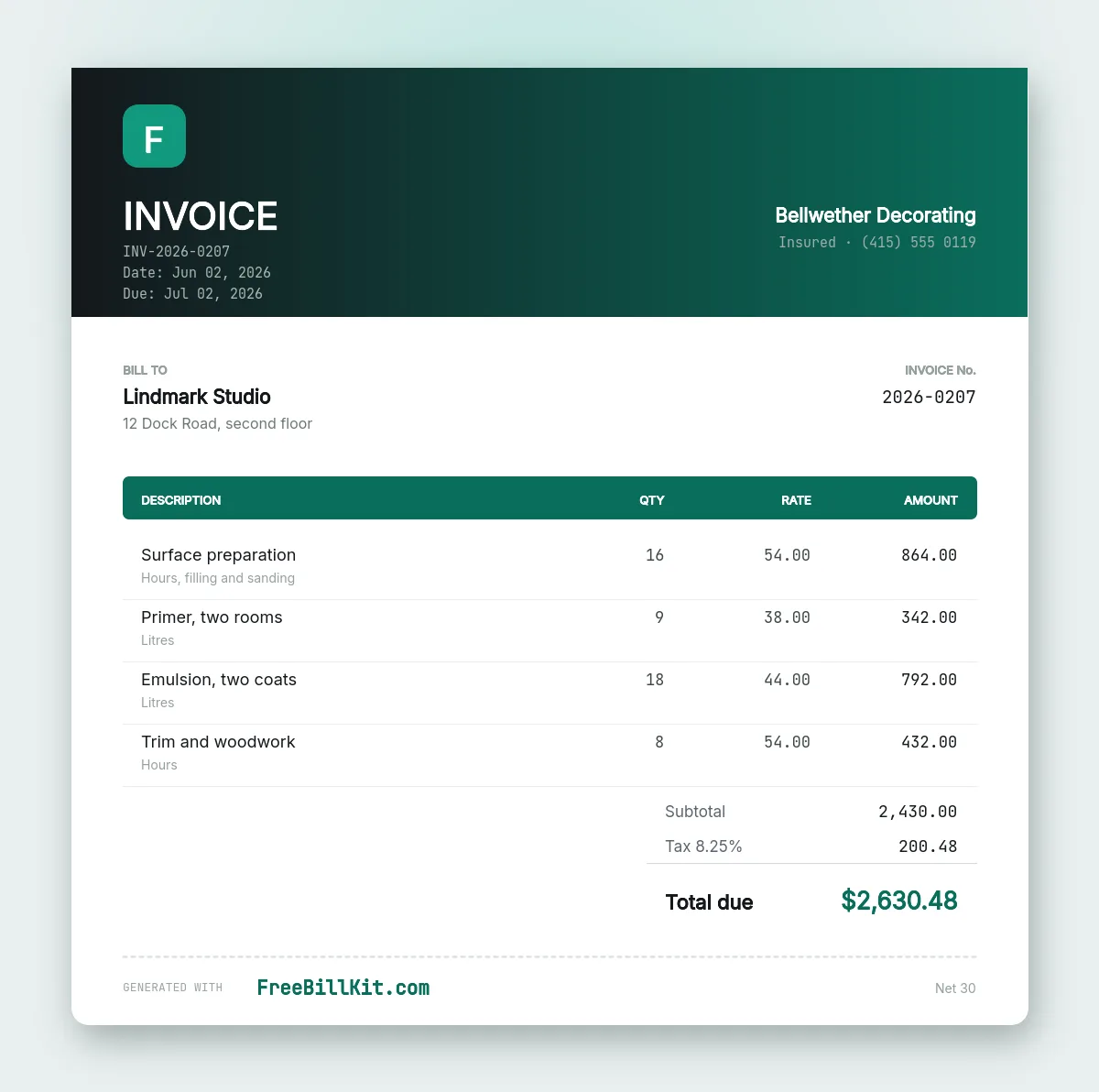
No signup. Fill it in and download the PDF in under a minute.
Nearly every painting dispute traces back to the same two words: prep and coats. A customer who was quoted for two coats and received one will notice, and a customer who did not realise that filling, sanding and caulking a hundred-year-old trim run was billable will be surprised. Both problems disappear when the invoice separates them.
What goes on a painting invoice
| Line | What it covers |
|---|---|
| Surface & area | Rooms, walls, ceilings, trim, doors, with area or count |
| Prep work | Filling, sanding, caulking, masking, pressure washing |
| Coats | Primer plus how many finish coats were applied |
| Paint & materials | Product, sheen and gallons used; sundries |
| Labour | Hours × rate, or the agreed price per room or area |
| Access equipment | Scaffolding, lifts or ladders on exterior work |
A worked example
Interior repaint of three rooms plus trim, invoiced on completion:
- Prep: fill, sand and caulk, 3 rooms, 6.0 hrs @ $55.00/hr: $330.00
- Walls and ceilings, 3 rooms, primer + 2 coats: $1,150.00
- Trim and doors, 2 coats: $420.00
- Paint: 9 gal eggshell + 2 gal semi-gloss: $486.00
- Sundries: tape, filler, drop sheets: $68.00
- Subtotal $2,454.00 · tax as applicable · due in 14 days
Prep is six hours on its own line and the coat count appears next to the work. Neither is a big detail, and together they remove almost every question a painting customer asks after the fact.
What causes painting disputes
- Coat count missing. “Two coats” is the single most common thing customers believe they were promised. Put it on the invoice.
- Prep buried in labour. On older properties prep can be half the job. Hidden, it looks like the painting itself was overpriced.
- Paint not identified. Product and sheen matter for touch-ups later, and the customer usually paid for the upgrade.
- Interior and exterior on one line. They carry different rates and conditions; keep them apart.
Create a painting invoice free
Add prep, coats, materials and labour, watch the total build, and download a clean PDF. No account, no watermark, and nothing is uploaded.
Quoting the job first? The quote and estimate generator covers the estimate stage, where coat counts and prep scope belong in writing.
Related trade templates
- Roofing invoice template
- Handyman invoice template
- Construction invoice template
- All templates · Quote vs estimate vs invoice
Frequently asked questions
Should prep work be billed separately from painting?
Yes. Filling, sanding, caulking and masking can account for a large share of the hours on older properties, and customers who see only a painting total assume the paint itself was overpriced. A separate prep line explains where the time went.
Do I need to state the number of coats?
It is the detail most worth including. Customers routinely remember being promised two coats, and an invoice that records primer plus two finish coats settles the question without anyone having to rely on memory.
Should I charge by room, square foot or hour?
Any of the three works. Per-room pricing is easiest for residential customers to understand, square footage suits larger commercial jobs, and hourly fits repair-heavy work where scope is unpredictable. What matters is stating on the invoice which basis was used.