What Is a Purchase Order? How POs Work and When You Actually Need One
By FreeBillKit Team · June 29, 2026 · Updated July 30, 2026
A purchase order (PO) is a document the buyer sends to the seller to formally request goods or services at an agreed price. It comes before the invoice: the buyer raises the PO to commit to the order, and the seller later invoices against it. In short: the PO is the order, the invoice is the bill for that order.
If you’ve ever received an email from a client’s accounts team asking you to “quote the PO number on your invoice,” and quietly wondered what they meant, you’re in good company. Purchase orders are everywhere in business-to-business work, yet plenty of capable freelancers and small suppliers go years without ever issuing or receiving one. Then a bigger client comes along, the PO becomes mandatory, and suddenly it’s worth understanding properly.
Here’s what a PO actually does, how it fits with the invoice, and when it’s genuinely useful versus when it’s just paperwork for paperwork’s sake.
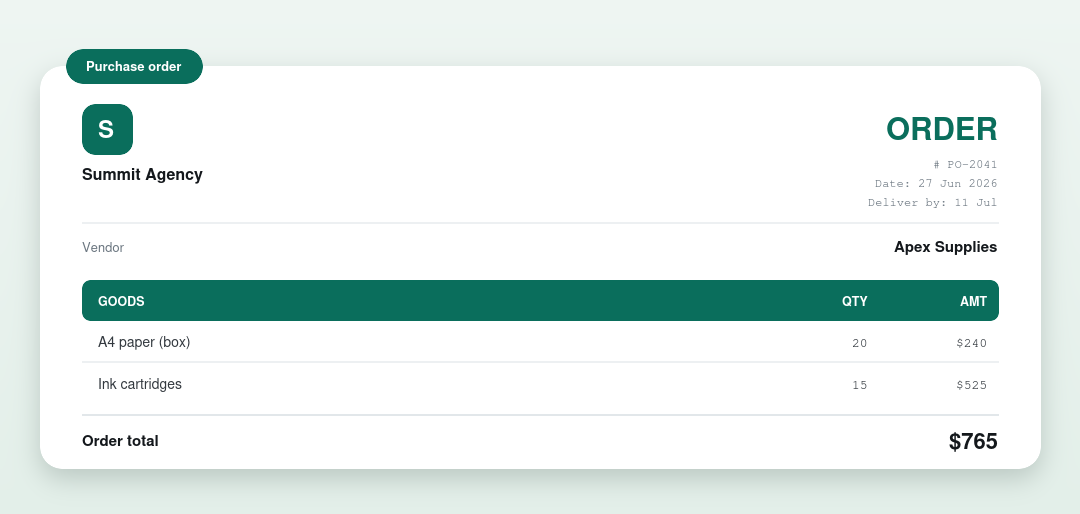
What a purchase order actually is
A PO is the buyer’s formal way of saying “yes, send me this, at this price, on these terms.” It’s created and issued by the buyer, which is the part that trips people up. Almost every other billing document flows from the seller, but the PO runs the other way. Once the seller accepts it, the PO becomes a binding agreement covering what’s being bought, how much of it, the agreed price, and the delivery and payment terms.
That’s its real job: turning a loose “can you do this?” conversation into a documented commitment both sides can point back to.
Purchase order vs invoice: who issues what, and when
The two are often confused because they list almost identical information. The difference is direction and timing.
The buyer issues the PO first to authorise the purchase. The seller fulfils it, then sends an invoice that quotes the same PO number. That shared number is what lets a finance team confirm they’re paying for something they actually ordered. If you’re fuzzy on how the invoice itself should be built, our guide on writing an invoice covers every field.
The three-way match (and why finance teams love POs)
In any organisation with a proper accounts department, your invoice gets checked against two other documents before it’s paid: the purchase order and the goods-received note. Accountants call this the three-way match: PO says what was ordered, the receipt confirms what arrived, and the invoice says what’s being charged. When all three agree, payment is approved almost automatically.
This is also why invoices without a PO number tend to stall at larger clients. There’s nothing to match against, so the invoice drops into a manual review queue and waits. Quoting the PO number isn’t bureaucratic fussiness; it’s the single fastest way to get paid by a big company.
What belongs on a purchase order
A workable PO carries:
- A unique PO number and the date raised
- Buyer and seller (supplier) details
- A clear description of each item or service, with quantity and agreed unit price
- Delivery date and address
- Payment terms: this is where something like Net 30 gets agreed up front
- Any tax and the order total
It looks a lot like an invoice on purpose. The closer they mirror each other, the easier the eventual match.
When you actually need purchase orders
POs earn their place when orders get bigger, more frequent, or involve more than one decision-maker:
- Selling to medium and large companies. Many simply won’t pay an invoice that has no matching PO. If a client mentions one, ask for it before you start.
- Recurring or high-value supply. POs create a paper trail that protects both sides when money and volume are significant.
- Internal spending controls. On the buyer side, requiring a PO before anyone commits budget is how businesses stop unapproved spending.
And when you probably don’t need them: one-off jobs, small-value work, or dealing with sole traders and individuals. For a freelancer billing a handful of small clients, a clean invoice does the whole job, no PO required. If you mostly sell smaller services, you may never need more than a free generator, which we weighed up in free invoice generator vs invoicing software.
If you’re the buyer: issuing a clean PO
Raising a PO yourself is straightforward, and it’s worth doing even informally when you’re committing to a meaningful order. It pins down the price before work starts, which heads off the awkward “that’s not what we agreed” conversation later. Keep your PO numbers in a clean sequence, send it before the supplier begins, and you’ve set the whole transaction on solid footing. A close cousin worth knowing is the proforma invoice, which a seller sends to confirm costs before a sale, useful when the buyer needs a figure to raise their PO against.
Common mistakes
- Invoicing without the PO number. The number one cause of slow payment from big clients. Always carry it across.
- Mismatched details. If the PO says 100 units and the invoice says 90, the match breaks and payment pauses. Keep them aligned.
- Skipping the PO on a big job. A handshake feels faster until there’s a dispute over scope or price with nothing in writing.
Create a clean, numbered PO in a couple of minutes with our free Purchase Order Generator: add your items, set the terms, download the PDF. No signup, no watermark.
Once the sequence clicks, PO to order and invoice to bill with a matching number tying them together, purchase orders stop feeling like corporate red tape and start looking like what they are: a simple way to agree on the deal before anyone spends money.
A quick example, start to finish
Say a marketing agency wants to buy 50 hours of your design time. Their operations lead raises purchase order PO-2041 for “50 hours design, £60/hr, £3,000, Net 30” and emails it over before you touch the work. You accept, do the hours, and send an invoice that shows, in a prominent spot, PO-2041. Their accounts team pulls up PO-2041, sees the work was approved at that rate, confirms it was delivered, and releases payment, no chasing, no “who approved this?” The PO number did the heavy lifting. Now picture the same invoice with no PO reference: it lands in a pile, someone has to track down who ordered the work, and payment waits an extra week or two for no reason beyond missing paperwork. Repeat that across every invoice and it’s the difference between a supplier who gets paid smoothly and one who’s forever wondering where the money went.
Purchase order vs sales order
One more term you’ll bump into. A purchase order is raised by the buyer; a sales order is the seller’s internal confirmation of that same order once they accept it. Same transaction, two viewpoints. As a small supplier you rarely need to formalise a sales order. Accepting the PO and invoicing against it is enough, but it’s handy to recognise the word when a larger client’s system uses it.
Purchase order vs invoice
| Purchase order | Invoice | |
|---|---|---|
| Who creates it | The buyer | The seller |
| When | Before the goods ship | After delivery |
| Purpose | Authorises and orders | Requests payment |
| Has a due date | No | Yes |
| Legal role | An offer to buy | A request for payment |
Frequently asked questions
Who issues a purchase order, the buyer or the seller?
The buyer. A purchase order is the buyer’s formal request to buy goods or services at an agreed price. The seller then fulfils it and issues an invoice in return.
What is the difference between a purchase order and an invoice?
A purchase order comes first and is sent by the buyer to place an order. An invoice comes after delivery and is sent by the seller to request payment. The invoice usually references the PO number so the two can be matched.
Is a purchase order legally binding?
Once the seller accepts it, a purchase order generally becomes a binding contract covering the items, price, and terms stated on it. That’s a large part of why businesses use them.
Do small businesses and freelancers need purchase orders?
Often not. For small, one-off jobs a clear invoice is enough. POs become important when you sell to larger companies that require them, or when orders are high-value or recurring.
What is a PO number and why does it matter?
It’s the unique reference on a purchase order. Quoting it on your invoice lets the client’s finance team match the invoice to the original order, which is usually the fastest route to getting paid.
n