Roofing Invoice Template
A roofing invoice bills by the square (100 sq ft of roof area), not by the square foot. Show tear-off separately from installation, list underlayment, flashing and disposal, and if the job is an insurance claim, reference the claim number and whether you are billing actual cash value or replacement cost. Build one free below.
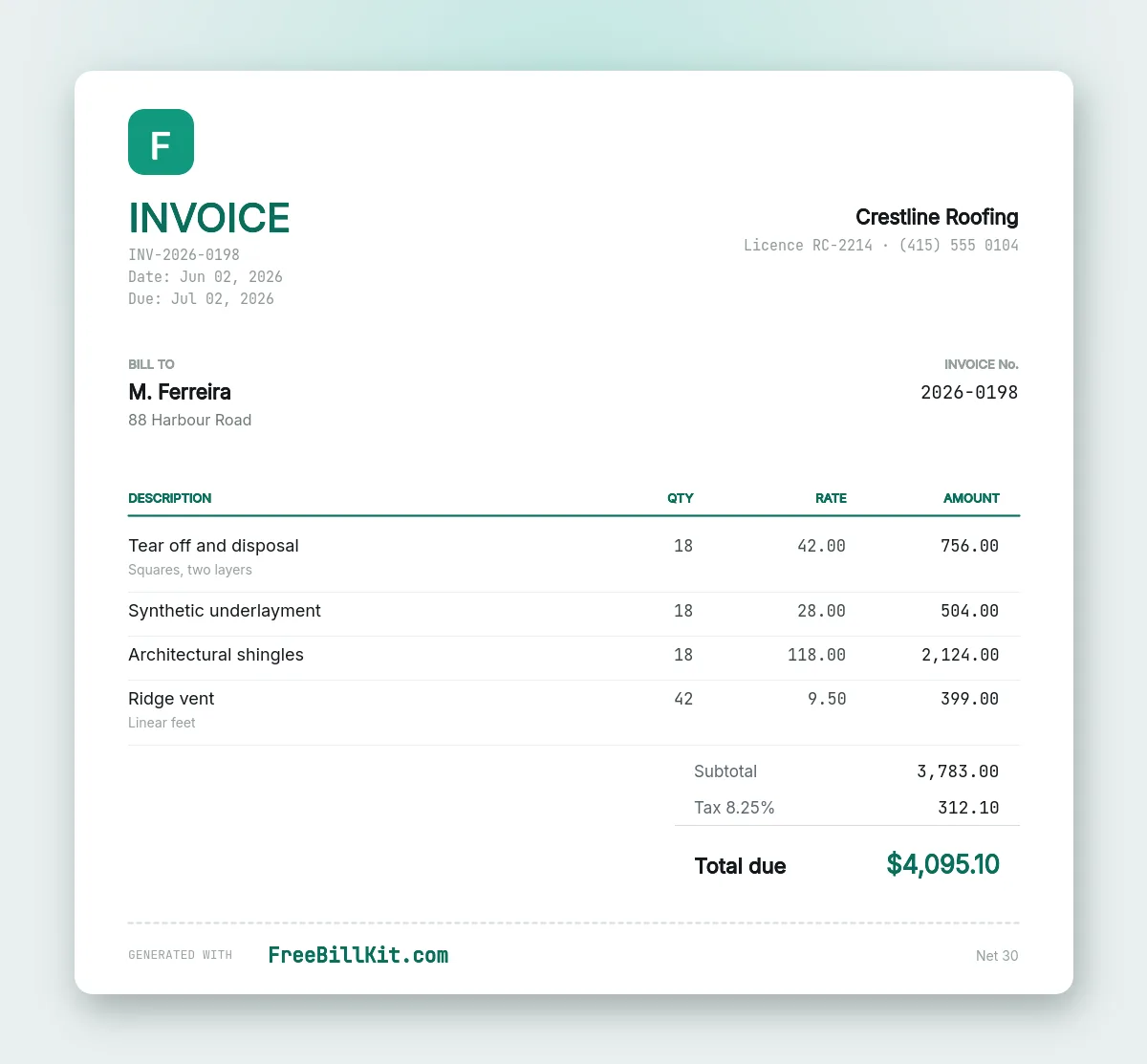
No signup. Fill it in and download the PDF in under a minute.
Roofing has two billing conventions that trip up anyone coming from another trade. The first is the unit: roofers price in squares, and a homeowner reading “28 squares” on an invoice needs that translated at least once. The second is insurance. A large share of residential roofing is paid by a carrier rather than the homeowner, and a carrier reads the invoice line by line against its own scope.
What goes on a roofing invoice
| Line | What it covers |
|---|---|
| Roof area | Squares (1 square = 100 sq ft), with pitch noted |
| Tear-off | Removal of existing layers, priced per square, per layer |
| Materials | Shingles, underlayment, ice and water shield, ridge, flashing |
| Labour | Installation, usually per square rather than hourly |
| Disposal | Dumpster and haul-away of tear-off debris |
| Claim reference | Insurance claim number, adjuster and ACV or RCV basis |
A worked example
A full residential tear-off and re-roof on a 28-square roof:
- Roof area 28 sq (2,800 sq ft) · pitch 6/12
- Tear-off, 1 layer, 28 sq @ $55.00/sq: $1,540.00
- Architectural shingles, 28 sq @ $130.00/sq: $3,640.00
- Synthetic underlayment and ice & water shield: $780.00
- Drip edge, ridge vent and flashing: $520.00
- Installation labour, 28 sq @ $95.00/sq: $2,660.00
- Dumpster and disposal: $450.00
- Subtotal $9,590.00 · tax as applicable · net 15
Tear-off is its own line at its own rate. Bundling removal into the installation price is the fastest way to have an insurance adjuster send the invoice back for a breakdown.
What holds up roofing payments
- Squares not converted. Note the square-foot equivalent once. Homeowners and adjusters both check it.
- Tear-off inside the install price. Carriers itemise removal separately; an invoice that does not will be queried.
- No claim number on insurance work. Without it the carrier cannot match your invoice to the file.
- ACV vs RCV not stated. Actual cash value pays depreciated; replacement cost releases the remainder after completion. The invoice should make clear which it is billing.
- Layers not counted. Tearing off two layers costs more than one. Say how many came off.
Create a roofing invoice free
Enter squares, tear-off, materials and disposal, watch the total build, and download a clean PDF for the homeowner or the carrier. No account, no watermark.
Bidding the job first? The quote and estimate generator produces the proposal. Ordering materials from a supplier? Use the purchase order generator.
Related trade templates
- Construction invoice template
- Painting invoice template
- Contractor invoice template
- All templates · How to write an invoice
Frequently asked questions
What is a square in roofing?
One roofing square equals 100 square feet of roof area. Roofers price materials and labour per square, so a 2,800 sq ft roof is billed as 28 squares. Noting the square-foot equivalent once on the invoice saves explaining it to every homeowner.
How do I invoice an insurance roofing claim?
Reference the claim number and adjuster, itemise tear-off, materials, labour and disposal separately, and state whether you are billing actual cash value or replacement cost. Carriers compare your invoice against their own scope, so a bundled total is far more likely to be sent back than a line-by-line one.
Should tear-off be a separate line?
Yes, and it should note how many layers were removed. Tear-off is priced per square per layer and is treated as a distinct scope item by insurers, so folding it into installation makes the invoice harder to approve.