GST Invoice Format (India): Mandatory Fields + Free Generator
GST Invoice Format
India’s GST law prescribes exactly what a tax invoice must contain. Section 31 of the CGST Act requires registered businesses to issue a tax invoice on every taxable supply, and Rule 46 of the CGST Rules lists the mandatory fields, from GSTINs and HSN codes to the tax breakup and place of supply. Miss a field and the invoice is non-compliant, which can also block your customer’s input tax credit.
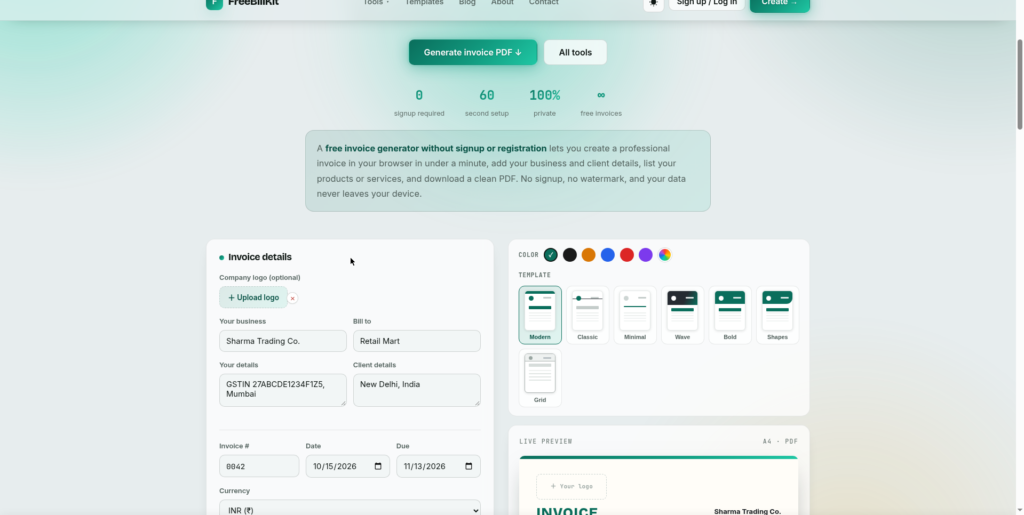
This page gives you a GST invoice format that follows Rule 46, plus a free generator that builds one in about a minute. You will find the full mandatory field checklist, a sample layout, when to issue a bill of supply instead of a tax invoice, and answers to the questions Indian businesses ask most.
Everything here is free. There is no signup and no watermark.
Create a GST invoice online
Enter the supplier and customer GSTINs, line items with HSN or SAC codes, quantities, and rates. The generator applies the tax breakup and produces a clean PDF you can download immediately. It works on phones, tablets, and desktops.
What the GST invoice format must include (Rule 46)
Rule 46 prescribes the particulars every tax invoice must carry. Check each invoice against this list before issuing it.
- Name, address, and GSTIN of the supplier.
- A consecutive serial number, unique for the financial year.
- Date of issue.
- Name, address, and GSTIN or UIN of the recipient, if registered.
- Name, address, and place of supply, if the recipient is unregistered.
- HSN code for goods or SAC code for services.
- Description of the goods or services.
- Quantity and unit of measurement.
- Total taxable value of the supply.
- Rate and amount of tax: CGST, SGST or UTGST, or IGST, shown separately.
- Place of supply along with the state name, which decides whether CGST plus SGST or IGST applies.
- A note where tax is payable on reverse charge basis.
- Signature or digital signature of the supplier or authorized representative.
The tax split follows the place of supply. A supply within the same state attracts CGST plus SGST. A supply moving between states attracts IGST. Getting this split wrong is one of the most common GST invoice errors. The CBIC GST portal publishes the governing rules: see the CBIC portal.
GST invoice format sample layout
A standard layout looks like this:
TAX INVOICE No. INV/2026-27/0042
Supplier: [Name, Address, GSTIN]
Recipient: [Name, Address, GSTIN]
Date: [Issue date] | Place of supply: [State]
Sr | Description | HSN/SAC | Qty | Rate | Taxable value
1 | [Item 1] | [HSN] | [Qty] | [Rate] | [Value]
2 | [Service 1] | [SAC] | [Qty] | [Rate] | [Value]
Total taxable value: [Amount]
CGST @[Rate]%: [Amount] | SGST @[Rate]%: [Amount]
(or IGST @[Rate]%: [Amount] for inter-state)
Total invoice value: [Amount]
Amount in words: [Amount in words]
Declaration: [Reverse charge note, if applicable]
Authorized signature: [Name + Signature]
Use one serial series per financial year and keep the numbering consecutive.
Handwritten GST invoice format
A handwritten GST invoice is fully valid. Rule 46 does not require a printed or digital format. It requires the mandatory fields. A bill book entry with the supplier GSTIN, serial number, date, recipient details, HSN codes, quantities, taxable value, tax breakup, place of supply, and signature meets the same requirements as a computer-generated invoice.
Handwritten bills are still common among small traders, transporters, and field sales teams. If you write invoices by hand, keep the serial numbers consecutive in a bound bill book, write the tax breakup on separate lines, and sign every copy. For a cleaner alternative that still takes a minute, the free generator above produces the same compliant format as a PDF.
Tax invoice vs bill of supply
Not every GST document is a tax invoice. Issue the right one:
| Tax invoice | Bill of supply | |
|---|---|---|
| Issued by | Regular registered dealer | Composition dealer, or any dealer on exempt supplies |
| Shows | Taxable value plus GST charged | Value without tax |
| Tax effect | Charges GST, enables input tax credit for the buyer | No tax charged, no credit available |
| HSN/SAC | Required | Required |
| When used | Taxable supplies | Exempt supplies, composition scheme sales |
If you are a regular dealer making taxable supplies, you issue a tax invoice. If you are under the composition scheme or selling exempt goods or services, you issue a bill of supply.
GST invoice format for reverse charge
Under reverse charge, the buyer pays the GST instead of the supplier. When this applies, the invoice must state that tax is payable on reverse charge basis. Common reverse charge situations include specified services and purchases from unregistered dealers as notified. Mark the declaration line on the sample layout above clearly. The buyer needs this note to account for the tax correctly in their returns.
E-way bill and the GST invoice
When goods move and the consignment value exceeds Rs 50,000, an e-way bill is required under Rule 138 in addition to the tax invoice. The invoice documents the sale; the e-way bill registers the movement on the GST portal. For goods moving without a sale, such as job work or branch transfers, a delivery challan covers the movement instead. See our delivery challan template for that format.
Who must issue a GST invoice
Every registered dealer making taxable supplies must issue a tax invoice. This covers manufacturers, traders, service providers, and e-commerce sellers registered under GST.
Unregistered businesses cannot issue a GST tax invoice because they have no GSTIN and charge no GST. They issue a regular bill instead. Composition dealers, who pay tax at a flat rate, issue a bill of supply rather than a tax invoice.
Input tax credit connects directly to invoice quality. Your customer can only claim credit on a valid tax invoice that shows your GSTIN, their GSTIN, and the correct tax breakup. A sloppy invoice does not just risk your compliance; it costs your customer money.
GST invoice format mistakes that cause problems
Wrong HSN or SAC codes. Wrong codes misclassify your supply and invite scrutiny. Look up the correct code for each item before invoicing.
Broken serial numbers. Gaps or duplicates in invoice numbering raise questions during audits. Keep one consecutive series per financial year.
Missing place of supply. Without it, the CGST plus SGST versus IGST split cannot be determined. Always state the place of supply with the state name.
Wrong tax split. Charging CGST plus SGST on an inter-state supply, or IGST on an intra-state one, is a common and costly error. Let the place of supply decide.
Missing reverse charge note. Where reverse charge applies and the note is absent, the buyer cannot account for the tax correctly. Add the declaration every time.
GST invoice format FAQs
Is this GST invoice format free?
Yes. Generate as many GST invoices as you need with the free online tool. No signup, no payment, no watermark, and no download limits.
What is a GST invoice?
A GST invoice, formally called a tax invoice under Section 31 of the CGST Act, is the document a registered dealer issues on taxable supplies. It shows GST charged and lets the buyer claim input tax credit.
What is a GST bill?
A GST bill is the informal term for the invoice or bill of supply used under GST. If it shows tax charged by a registered dealer, it is a tax invoice; if it shows no tax, it is a bill of supply.
How to make a GST bill?
Enter the supplier and customer GSTINs, add line items with HSN or SAC codes, quantities and rates, apply the CGST/SGST or IGST breakup based on place of supply, add a serial number and signature. The free generator above does this in about a minute.
When should I issue a bill of supply instead of a tax invoice?
When you are a composition dealer, or when the supply is exempt from GST. A bill of supply shows the value without tax and does not allow the buyer to claim input tax credit.
Which HSN or SAC code do I use?
Use the HSN code that matches your goods and the SAC code that matches your services. The code depends on what you sell, not on your business type. Check the official HSN/SAC lists when adding a new product or service.
How should my invoice numbers run?
Number invoices consecutively in one series per financial year, with no gaps or duplicates. A format like INV/2026-27/0042 keeps the financial year visible and the sequence clear.
Do I need to show CGST and SGST separately?
Yes. Show each tax head on its own line with its rate and amount. For intra-state supplies show CGST and SGST separately; for inter-state supplies show IGST.
What is place of supply and why does it matter?
Place of supply is the state where the supply is treated as happening. It decides whether you charge CGST plus SGST (same state) or IGST (different states). Always state it on the invoice.
What if my customer is unregistered?
Show the customer’s name, address, and place of supply instead of a GSTIN. The invoice still needs all other mandatory fields, including HSN codes and the tax breakup.
Is a signature mandatory on a GST invoice?
The invoice must be signed or digitally signed by the supplier or an authorized representative. An unsigned invoice does not meet the Rule 46 requirements.
Can I issue a GST invoice for services?
Yes. Use SAC codes instead of HSN codes, describe the service, and show the same mandatory fields: GSTINs, consecutive serial number, date, taxable value, tax breakup, and place of supply.
Is a handwritten GST invoice valid?
Yes. Rule 46 requires the mandatory fields, not a printed format. A handwritten bill book entry with GSTINs, serial number, HSN codes, tax breakup, and signature is fully compliant.
Related templates
- Invoice Generator: create a GST invoice online in about a minute
- Delivery Challan Template: for goods moving without a sale
- Commercial Invoice Template: for international shipments
- Purchase Order Template: ordering before dispatch