Free Commercial Invoice Template
Customs officers hold shipments that arrive with missing or vague paperwork, and the commercial invoice is one of the first documents they check. Download the free template below in Word or PDF, or build one online in about a minute. Fill in the seller, buyer, HS codes, Incoterms, currency, declared value and a signed declaration, and your shipment has what customs needs to calculate duty and release the goods.
Download Free Commercial Invoice Template
Choose your format. No signup required.
⬇ Download PDF
⬇ Download Word
Need to customize? Use our free generator →
No signup. Fill it in and download the PDF in under a minute.
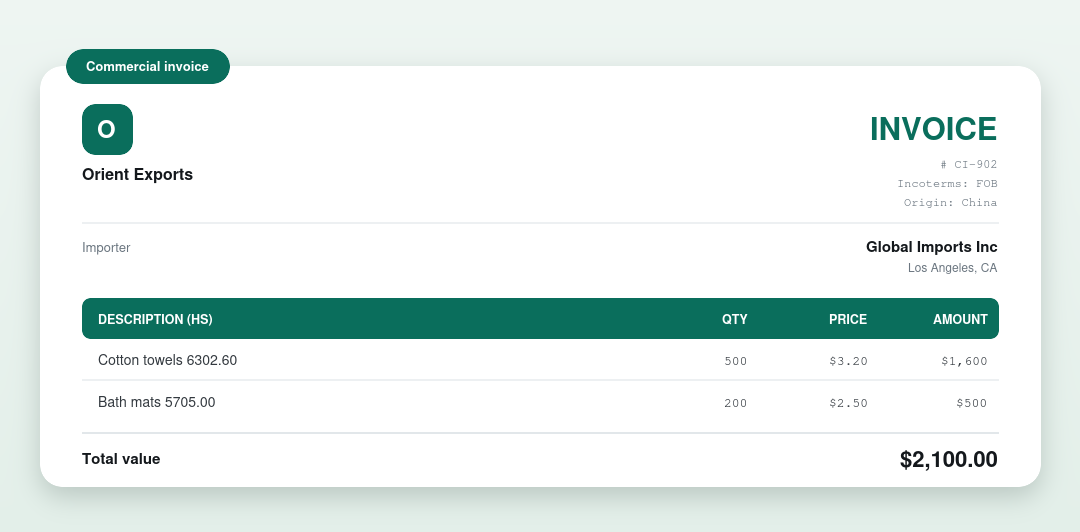
Last updated October 2026. This is general guidance, not customs or legal advice. Confirm the rules for your destination with your carrier or a licensed customs broker.
What is a commercial invoice?
A commercial invoice is the bill of sale for goods that cross a border. It tells customs in the destination country what is being shipped, who is selling it, who is buying it and how much it is worth. Customs uses it to classify the goods, apply the right duty and taxes, and decide whether to release the shipment. It differs from a domestic invoice because it carries trade details such as the HS code, the country of origin and the Incoterms.
What must a commercial invoice include?
Requirements vary a little by country, but customs authorities and carriers expect the same core fields. Use this checklist as your baseline.
| Field | What to write | Why it matters |
|---|---|---|
| Seller (exporter) | Legal business name, full address, phone or email, and a tax or EORI number if you have one | Identifies who is responsible for the export |
| Buyer (consignee) | Name, full delivery address and contact details. Add the importer of record if it is a different company | Customs needs to know who receives the goods and who pays duty |
| Invoice number and date | A unique number such as CI-2026-0148 and the issue date | Lets customs, your carrier and your accountant match documents |
| Description of goods | Plain, specific wording: ceramic mugs, not household items | Vague wording is the most common reason for holds and inspections |
| HS code | Six digits are standard worldwide. Many countries add more digits for their own tariff | Decides the duty rate and whether import rules apply |
| Quantity and unit price | Per line item, with the unit of measure | Lets customs check your total |
| Total value and currency | The full value plus the currency code, such as USD or EUR | Duty is usually calculated on this value |
| Country of origin | Where each item was made | Affects duty rates and trade agreement eligibility |
| Incoterms | A three-letter rule such as FOB or DDP, with the named place | Shows who pays freight, insurance and duty |
| Reason for export | Sale, sample, repair, return or gift | Changes how customs treats the value |
| Weight and packages | Number of cartons, gross and net weight | Must match the packing list and the carrier waybill |
| Payment terms | For example, 30 days from invoice date, or prepaid | Supports the declared transaction value |
| Declaration and signature | A statement that the details are true, with a name, title and signature | Makes you accountable for what you declared |
Commercial invoice example
This sample shows how the fields come together on a real shipment. The companies, person and codes are made up for illustration, so confirm your own HS codes in your national tariff database or with your customs broker.
| Detail | Example |
|---|---|
| Seller | Northline Goods Ltd, 14 Canal Street, Manchester M1 2AB, United Kingdom |
| Buyer | Harbor Home Imports LLC, 820 SW Front Ave, Portland, OR 97204, USA |
| Invoice number and date | CI-2026-0148, 12 September 2026 |
| Incoterms | CIF Portland (Incoterms 2020) |
| Country of origin | United Kingdom |
| Reason for export | Sale |
| Payment terms | 30 days from invoice date |
| Packages | 2 cartons, 64 kg gross |
| Description | HS code | Qty | Unit price | Total |
|---|---|---|---|---|
| Ceramic mugs, 350 ml, white glaze | 6912.00 | 120 | USD 4.50 | USD 540.00 |
| Cotton tote bags, printed | 4202.22 | 80 | USD 3.25 | USD 260.00 |
| Goods subtotal | USD 800.00 | |||
| Freight and insurance (CIF) | USD 107.00 | |||
| Total invoice value | USD 907.00 |
Declaration: I declare that the information on this invoice is true and correct. Signed: A. Patel, Export Manager.
How do you fill out a commercial invoice, step by step?
- Put your seller details at the top, then the buyer and the delivery address. If another company clears customs, add it as the importer of record.
- Give the invoice a unique number and a date. Keep numbers in sequence so you can trace each shipment later.
- List every item on its own line with a specific description, quantity, unit price and line total.
- Add the HS code and country of origin to each line. If you are unsure of a code, look it up in the destination country’s tariff database before you ship.
- State the currency. Add freight and insurance only if your Incoterm makes you responsible for them.
- Choose the Incoterm and name the place, for example CIF Portland.
- Sign the declaration, then check that weights, package counts and values match your packing list and carrier booking.
Want to skip the layout work? Our commercial invoice generator has a field for each of these and downloads a clean PDF.
What is the difference between a commercial invoice and a proforma invoice?
A commercial invoice is the final bill for a completed sale, and customs relies on it to set duty. A proforma invoice is a preview sent before the sale to confirm price and terms. It is also used when goods ship without a sale, such as samples or returns. Carriers often accept a proforma for no-charge shipments, but rules vary, so check with yours. Read proforma vs commercial invoice for the full comparison, or use the proforma invoice template.
Which Incoterms should you use?
Incoterms are standard trade terms published by the International Chamber of Commerce. The current set, Incoterms 2020, has 11 rules. These five come up most often.
| Incoterm | Seller covers | Buyer takes over |
|---|---|---|
| EXW (Ex Works) | Making the goods available at the seller’s premises | Loading, export clearance, freight, import clearance and duty |
| FOB (Free On Board) | Delivery and export clearance up to loading on the ship | Sea freight, insurance, import clearance and duty |
| CIF (Cost, Insurance and Freight) | Sea freight and minimum insurance to the destination port | Unloading, import clearance and duty |
| DAP (Delivered at Place) | Transport to the named destination | Import clearance and duty |
| DDP (Delivered Duty Paid) | Everything, including import duty and taxes | Receiving the goods |
FOB and CIF are meant for sea and inland waterway freight. For air or road shipments, FCA, CPT or CIP usually fit better.
Which mistakes delay shipments at customs?
Most holds come from small paperwork problems that were easy to avoid.
- Vague descriptions such as parts, samples or gifts. Name the product and what it is made of.
- Missing or wrong HS codes, which lead to the wrong duty rate or a request for more documents.
- A value that does not match the payment or the packing list. Customs compares them.
- No Incoterm, so nobody knows who owes freight and duty.
- No country of origin on each line.
- An unsigned declaration, or a signature with no name and title.
- Understating the value to lower duty. Customs authorities treat this as a serious offence, and penalties can include fines and seizure of the goods.
Do you need a commercial invoice for every international shipment?
Almost always. The rules differ by country, shipment value and carrier, and some low-value shipments get simplified treatment. The safe habit is to include a commercial invoice with every international shipment and keep a signed copy. Carriers such as DHL, FedEx and UPS publish their own guidance, so check the one you use. For the wider export process, read our guide to the commercial invoice for exports.
Related templates
- Proforma invoice template
- Purchase order template
- Credit note template
- Delivery note template
- Invoice template · Receipt template · Quote template
Frequently asked questions
Is the commercial invoice template free?
Yes. The Word and PDF templates are free with no signup and no watermark. The online commercial invoice generator is free too.
What should a commercial invoice include?
Seller and buyer details, invoice number and date, a specific description of each item, HS codes, quantity, unit price, total value and currency, country of origin, Incoterms, reason for export, weight and packages, and a signed declaration.
Do I need HS codes on a commercial invoice?
For most international shipments, yes. The first six digits of an HS code are the same worldwide, and the destination country adds more digits for its own tariff. Missing codes are a common cause of delays.
What is the standard format for a commercial invoice?
There is no single mandatory layout. Customs cares that the required information is present, legible and signed. Many carriers and countries require it in English, so check the rules for your destination.
Can I create my own commercial invoice?
Yes. No official form is required. You can use a template or a generator as long as it contains the required fields and carries a signed declaration.
How many copies of a commercial invoice do I need?
It depends on the destination and the carrier. Many carriers accept the invoice electronically, while others want printed copies attached to the parcel. Ask your carrier or customs broker, and keep a signed copy for your records.
Who signs a commercial invoice?
An authorised person at the exporting company, such as the owner, a director or the export manager, who can confirm the details are true.