Free Estimate Template
An estimate template gives clients an approximate price for a job before you commit to a fixed quote. It is the right document when the scope is not fully clear yet and the final cost could shift. Contractors, repair services, and project-based businesses use estimates to start the conversation without locking in a price too early.
On this page you get a free estimate template two ways. Download the Word or PDF file below, or use the online generator to build one in about a minute. Further down you will find what every estimate must include, how an estimate differs from a quote, and answers to the questions businesses ask most.
Everything here is free. There is no signup and no watermark.
Download the estimate template
Choose the format that suits you. The Word file stays editable for adding your logo and adjusting line items. The PDF is print-ready.
Download Estimate Template – Word (.docx)
Download Estimate Template – PDF
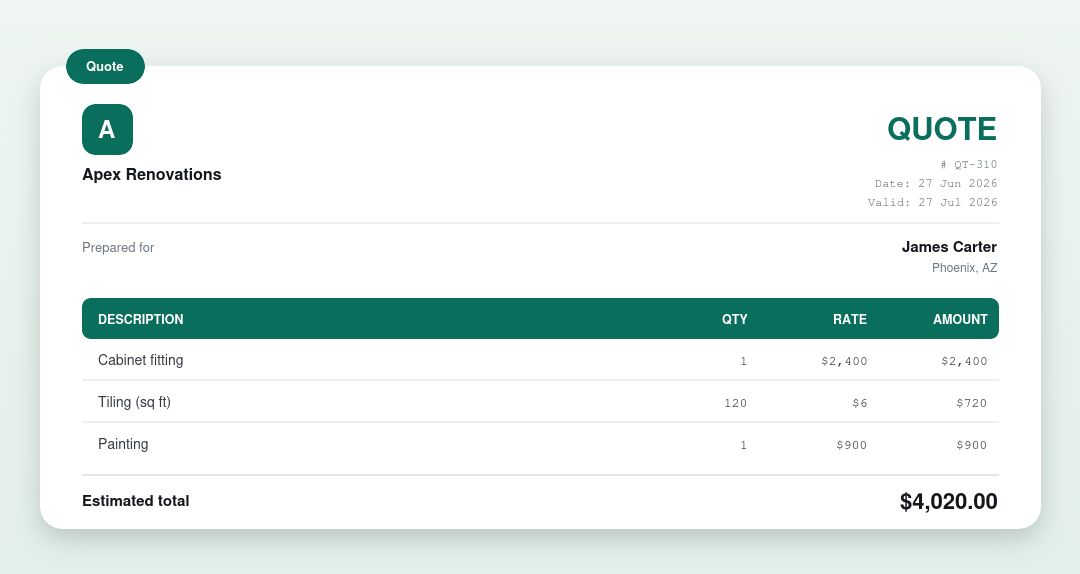
If the scope is already clear and you can commit to a fixed price, use the quote template instead.
Create an estimate online with this estimate template
Enter your business details, the client, line items, and rates. The generator totals everything up and produces a clean PDF you can download immediately. It works on phones, tablets, and desktops.
Open the Free Quote & Estimate Generator
What is an estimate
An estimate is an approximate price for work not yet fully scoped. It tells the client what the job will probably cost, with the understanding that the final figure may move once the details are clear. This honesty up front is exactly why estimates exist: they let both sides start talking before every variable is nailed down. (For SBA guidance on pricing your services, see the U.S. Small Business Administration.)
Estimates work best early in the sales process. A contractor bidding on a renovation, a repair shop diagnosing a problem, or an agency scoping a project all benefit from putting an approximate number on paper first. It filters serious buyers from tire kickers without committing either side.
An estimate is not a quote. The estimate comes first with an approximate figure. The quote follows later with a fixed price, once the scope is firm.
What your estimate template must include
An estimate missing key details confuses clients about what the number means. Include all eight of these:
- Your business name, address, and contact details.
- Client name and address.
- Unique estimate number and issue date.
- Itemized list of expected work with descriptions, quantities, and rates.
- Subtotal, tax if applicable, and the total estimated price.
- Clear label that this is an estimate, not a fixed quote (print “ESTIMATE” at the top).
- Validity period, meaning how long the estimated pricing stands.
- Notes on what could change the final price, such as material costs or scope adjustments.
Estimate template format
A standard layout looks like this:
ESTIMATE No. EST-0042
From: [Your Business Name, Address]
To: [Client Name, Address]
Date: [Issue date] | Valid until: [Expiry date]
Item | Qty | Rate | Total
[Item 1] | [Qty] | [Rate] | [Total]
[Item 2] | [Qty] | [Rate] | [Total]
Subtotal: [Amount]
Tax: [Amount]
TOTAL ESTIMATED: [Amount]
Payment terms: [Terms]
Notes: [What could affect the final price]
Label it ESTIMATE clearly on every copy. That one word is what keeps it legally distinct from a fixed quote.
Estimate vs quote
This is the distinction that matters most on this page:
| Estimate | Quote | |
|---|---|---|
| Price type | Approximate, may change | Fixed, locked in |
| Commitment | Low (exploratory) | High (acceptance binds) |
| Best for | Unclear scope, variable costs | Clear scope, known costs |
| Timing | Earliest stage | After scoping |
| Legal weight | Generally not binding | Often binding once accepted |
| Next step | Usually a firm quote | Contract or invoice |
Send an estimate when costs could shift. Move to a quote once the scope is firm and you can stand behind the number.
When to use this estimate template
Contractors and trades. Renovation, repair, and construction work where material and labor costs vary.
Repair services. Auto shops, appliance repair, and technicians diagnosing problems before quoting a fix.
Project work. Agencies and consultants scoping engagements where the hours are not yet certain.
Early-stage bids. Responding to inquiries quickly with an approximate figure to keep the conversation moving.
Mistakes that cause problems
Presenting it as a fixed price. If the client reads your estimate as a quote, any increase feels like a broken promise. Label it ESTIMATE and say the figure is approximate.
No validity period. Cost assumptions expire. Without a date, clients expect old pricing to hold indefinitely.
Vague line items. Approximate does not mean unclear. Itemize the expected work so the client sees where the number comes from.
Forgetting the change clause. State what could move the final price: materials, scope changes, site conditions. One paragraph prevents most disputes.
Skipping the follow-up. An estimate is a conversation starter, not a closer. Follow up within a few days to move serious prospects toward a firm quote.
Estimate template FAQs
Is this estimate template really free?
Yes. Download the Word or PDF file free, or generate as many estimates as you need with the online tool. No signup, no payment, no watermark, and no download limits.
What is the difference between an estimate and a quote?
An estimate is an approximate price that may change as the scope becomes clear. A quote is a fixed price that locks in when the client accepts it. Use an estimate early; move to a quote when costs are certain.
Is an estimate legally binding?
Generally no. An estimate is an approximate figure, not a fixed commitment, which is why it carries less legal weight than a quote. Label it clearly as an estimate and state the price may change.
Should I put “estimate” or “quote” on the document?
Use whichever matches your intent. If the price could change, write ESTIMATE. If you are committing to the figure, write QUOTE. Mixing the labels creates legal confusion.
How accurate should an estimate be?
As accurate as you can make it with current information. Experienced businesses aim within 10 to 15 percent of the final figure. Big misses damage trust, so scope carefully before estimating.
How long should an estimate be valid?
Thirty days is common. Shorter periods suit volatile costs like materials. State the validity on the document so old estimates cannot be revived later.
Can I convert an estimate into a quote?
Yes, that is the normal progression. Once the scope firms up, issue a fixed quote referencing the estimate number. Our quote template covers that step.
Do I need to include tax on an estimate?
Show it either way, but be clear. State whether the estimated total includes tax or has tax added. Clients should never be surprised by tax at invoice time.
What trades use estimates most?
Construction, renovation, auto repair, appliance service, landscaping, and custom manufacturing – any work where the final cost depends on what is found during the job.
How do I follow up on an estimate?
Contact the client within a few days of sending it. Ask if the scope is clear, offer to firm it into a fixed quote, and keep the conversation moving toward a decision.
Related templates
- Quote & Estimate Generator: build one online in about a minute
- Quote Template: for fixed-price quotes
- Invoice Generator: bill after the job is done
- Proforma Invoice Template: formal pre-sale estimates