Trucking Invoice Template
A trucking invoice bills the linehaul rate (either per mile or a flat rate for the load), plus fuel surcharge and any accessorials such as detention, layover, lumper fees or extra stops. Always reference the load number, BOL number and broker PO, or the invoice will not clear accounts payable. Build one free below.
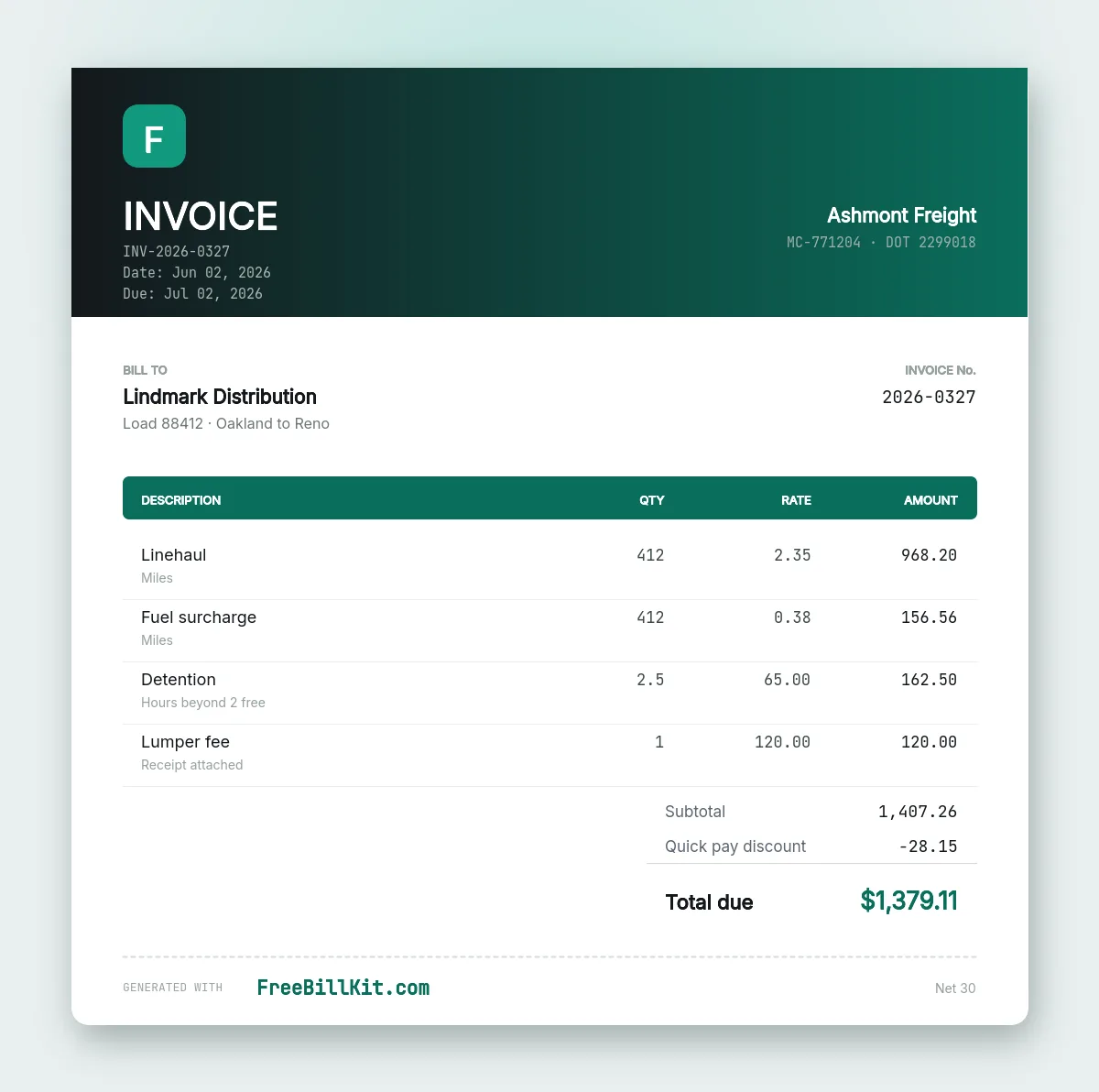
No signup. Fill it in and download the PDF in under a minute.
Getting paid in freight is less about the rate and more about the paperwork matching. A broker’s accounts payable system reconciles your invoice against their load record, and if the load number is missing or the accessorial has no supporting document, the invoice sits in a queue until someone chases it. Carriers who get paid quickly are usually the ones whose invoices need no chasing at all.
What goes on a trucking invoice
| Line | What it covers |
|---|---|
| Load / BOL / PO number | The references the broker matches against, the single most important field |
| Linehaul | Rate × loaded miles, or the agreed flat rate |
| Fuel surcharge | Per mile or as a percentage, shown separately |
| Detention | Hours beyond free time, with in and out times |
| Accessorials | Lumper, tarping, extra stop, layover, TONU |
| Origin & destination | Pickup and delivery cities with dates |
A worked example
A dry van load, Dallas to Memphis, invoiced the day after delivery:
- Load #48210 · BOL #77-3391 · broker PO on file
- Dallas, TX → Memphis, TN · picked 12 Aug, delivered 13 Aug
- Linehaul, 452 mi @ $2.35/mi: $1,062.20
- Fuel surcharge, 452 mi @ $0.38/mi: $171.76
- Detention at receiver, 2.0 hrs beyond 2 hrs free @ $50.00/hr: $100.00
- Lumper fee (receipt attached): $175.00
- Total $1,508.96 · terms: net 30, quick pay available
Detention shows the hours beyond free time rather than total time on site, and the lumper line references an attached receipt. Those two habits are the difference between an accessorial that gets paid and one that gets denied.
What gets freight invoices rejected
- No load or BOL number. Broker AP cannot match it to anything. This alone accounts for most delayed freight payments.
- Detention claimed without times. Show arrival and departure. A flat “detention $150” with no supporting times is routinely denied.
- Lumper with no receipt. Reimbursable costs need proof attached; without it the line comes off the payment.
- Fuel surcharge buried in the rate. Keep FSC separate. Many broker agreements calculate and audit it independently.
- Invoice sent without the signed POD. Most brokers will not start the payment clock until proof of delivery is in hand.
Create a trucking invoice free
Enter linehaul, fuel surcharge and accessorials, watch the total build, and download a clean PDF to send with your POD. No account, no watermark.
Hauling goods that need a delivery document too? The delivery note template and delivery challan generator cover that. Waiting on a slow-paying broker? See what to do when an invoice goes unpaid.
Related templates
- Delivery note template
- Auto repair invoice template
- Commercial invoice template
- All templates · What is net 30
Frequently asked questions
What must be on a trucking invoice to get paid?
The load number, BOL number and any broker PO reference, alongside origin, destination, dates and the rate breakdown. Broker accounts payable matches your invoice against their load record, so an invoice missing those references cannot be processed no matter how accurate the figures are.
How do I invoice detention so it actually gets paid?
Show the arrival and departure times, the free time allowed under the rate confirmation, and the billable hours beyond it. A detention line with no supporting times is the most commonly denied accessorial in freight billing.
Should fuel surcharge be a separate line?
Yes. Most broker agreements calculate and audit fuel surcharge independently of the linehaul rate, so folding it into a single per-mile figure invites the invoice being recalculated or queried.