Construction Invoice Template
A construction invoice is usually a progress bill: it shows the contract value, the percentage of work completed this period against the schedule of values, approved change orders, and retainage held back. Subtract previous payments to reach the amount due now. Build one free below, no signup.
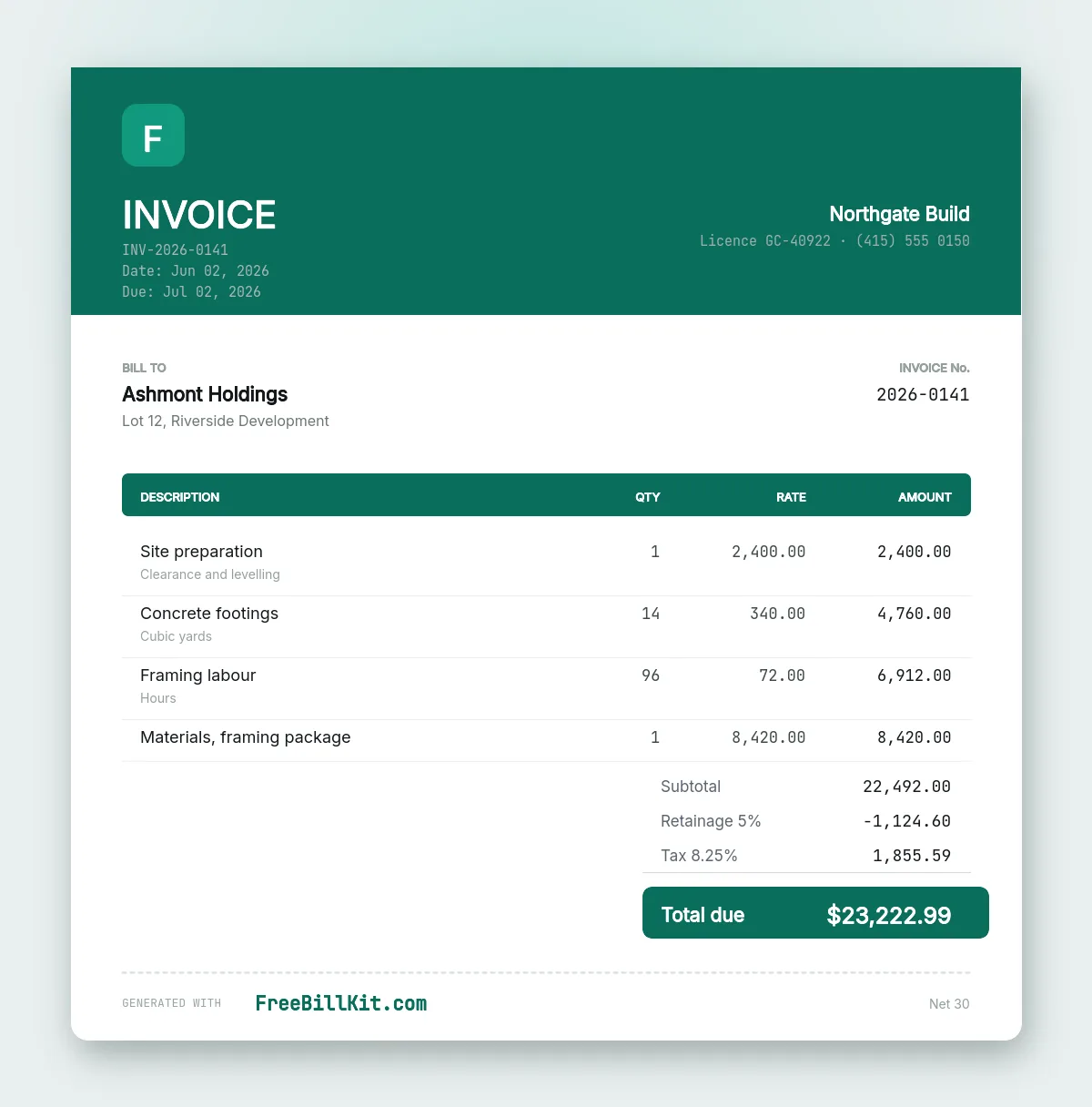
No signup. Fill it in and download the PDF in under a minute.
Construction billing is different from every other trade on this site because you are rarely invoicing for a finished job. You are invoicing for a slice of one. That means the invoice has to answer three questions at once: what is the total contract worth, how much of it is done, and how much has already been paid. Miss any of the three and the payment application goes back for revision.
What goes on a construction progress invoice
| Line | What it covers |
|---|---|
| Contract value | Original contract sum, plus approved change orders |
| Schedule of values | Each phase or division with its share of the contract |
| % complete this period | Work performed since the last application |
| Change orders | Approved extras, referenced by number and date |
| Retainage | The percentage held back, usually 5–10% |
| Less previous payments | What has already been paid to date |
A worked example
Application #3 on a $180,000 renovation contract:
- Original contract sum: $180,000.00
- Approved change orders (CO-01, CO-02): $12,400.00
- Revised contract sum: $192,400.00
- Total completed to date, 62%: $119,288.00
- Less retainage @ 10%, −$11,928.80
- Less previous payments, −$78,500.00
- Amount due this application $28,859.20 · net 30
Retainage is shown as a deduction rather than left out. The general contractor or owner is holding that money, not refusing it, and the invoice should make the distinction visible so it can be claimed at closeout.
What gets construction invoices returned
- Change orders not referenced. Extras billed without a CO number and approval date are the single most common reason a payment application is rejected.
- Percentages that do not reconcile. Completed-to-date must equal previous plus current. If it does not, the whole application stalls.
- Retainage omitted. If the contract holds 10%, the invoice must show it. Billing the full amount looks like an error at best.
- Missing lien waiver. Many owners will not release payment without a conditional waiver accompanying the application.
Create a construction invoice free
Enter your contract lines, change orders, retainage and previous payments, and download a clean PDF. No account, no watermark, nothing uploaded.
⇩ Create a construction invoice
Bidding the job first? The quote and estimate generator produces the proposal. Ordering materials from suppliers? Use the purchase order generator.
Related trade templates
- Contractor invoice template
- Electrician invoice template
- Plumbing invoice template
- All templates · What is net 30
Frequently asked questions
What is retainage on a construction invoice?
Retainage is a percentage of each progress payment, commonly 5 to 10%, that the owner or general contractor holds back until the project reaches completion. It should appear on every application as a visible deduction, and the accumulated total is claimed at closeout once the final work is accepted.
How do I bill for a change order?
Add it to the revised contract sum and reference its number and approval date on the invoice. Change orders billed without that reference are routinely rejected, because the owner’s records need to match the application line for line.
What is a schedule of values?
It is the contract broken into phases or divisions, each with its own dollar value, so progress can be billed as a percentage of each line rather than of the job as a whole. It makes a partial invoice checkable, which is why most commercial contracts require one.