Electrician Invoice Template
An electrician invoice bills a job in three parts: the call-out or service fee, labour hours at your rate, and materials such as cable, breakers and fixtures. Add your licence number, a permit line if one was pulled, and a due date. You can build one free below, no signup and no watermark.
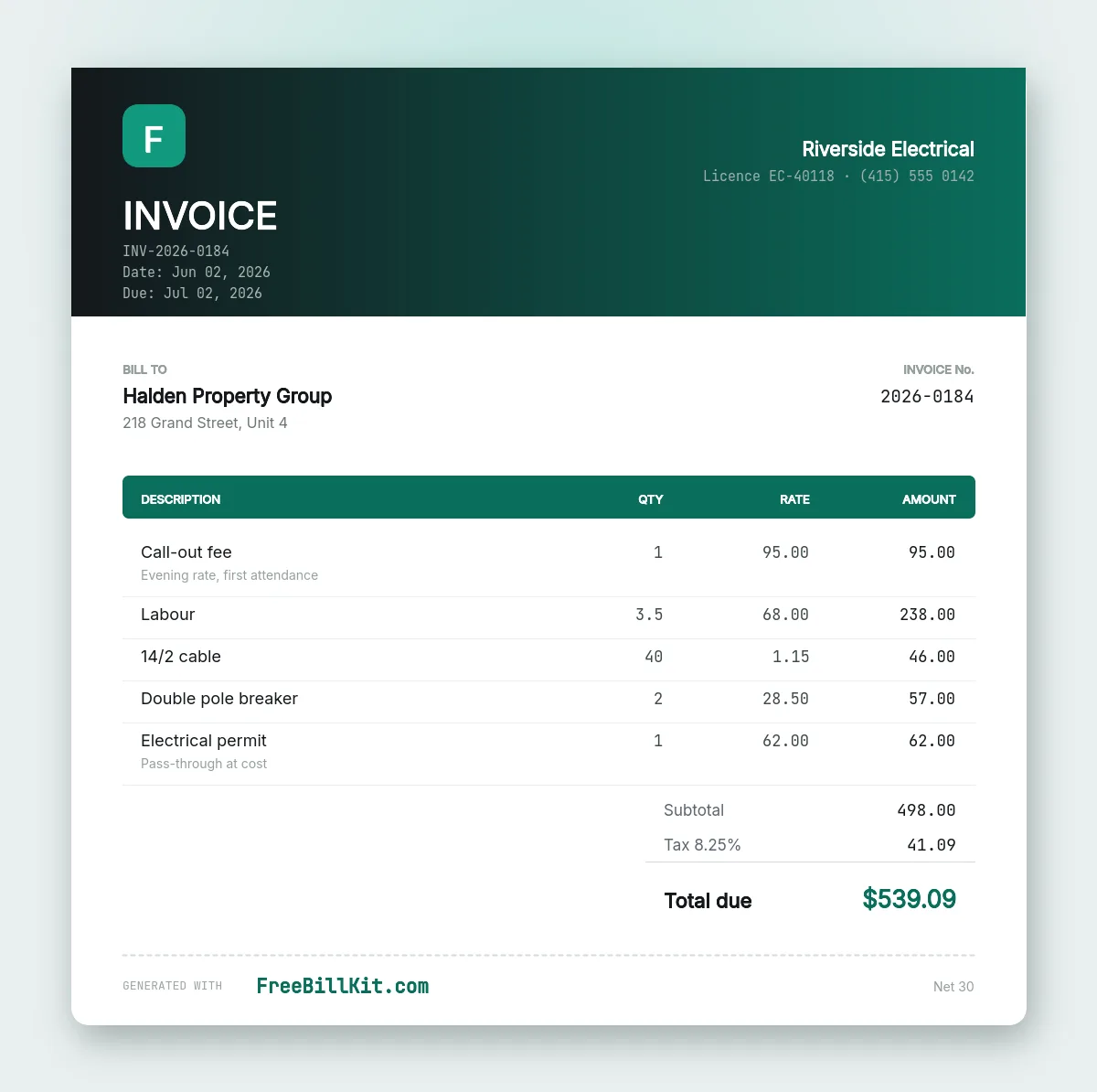
No signup. Fill it in and download the PDF in under a minute.
Electrical work is easy to under-bill because so much of the cost is buried in small parts and travel. A job that looks like “two hours” is often a call-out, two hours on site, forty dollars of cable and a permit you paid for up front. If the invoice does not separate those, clients query it, and queried invoices get paid late.
What goes on an electrician invoice
| Line | What it covers |
|---|---|
| Call-out / service fee | Travel and first attendance, charged once per visit |
| Labour | Hours on site × your hourly rate; show after-hours or emergency rates separately |
| Materials | Cable, breakers, outlets, fixtures, conduit, each with quantity |
| Permit & inspection | Any fee you paid and are passing through |
| Licence number | Required on invoices in many states and provinces |
| Totals & terms | Subtotal, tax, total due and a dated payment term |
A worked example
A 200A panel upgrade on a residential property, invoiced the day the work passed inspection:
- Service call: $85.00
- Labour, 6.0 hrs @ $95.00/hr: $570.00
- 200A load centre and breakers: $450.00
- Cable, conduit and fittings: $138.00
- Municipal electrical permit (pass-through): $120.00
- Subtotal $1,363.00 · tax as applicable · due in 14 days
Notice the permit sits on its own line. Pass-through costs bundled into labour look like padding; itemised, they read as exactly what they are.
What delays payment on electrical jobs
- “Labour and materials” as one line. The client cannot check it, so they ask, and the invoice sits for a week.
- No licence number. Commercial clients and property managers often will not process an invoice without it.
- Emergency rates applied silently. If you charged an after-hours multiplier, label it. Unexplained rate jumps trigger disputes.
- Missing job address. Landlords and managers pay per property; without the address they cannot allocate the cost.
Create an electrician invoice free
Fill in your lines, watch the totals update, and download a clean PDF. No account, no watermark, and it runs in your browser so client details are never uploaded.
⇩ Create an electrician invoice
Prefer a file to edit? The free invoice template comes in Word, Excel and PDF. If you also quote before starting work, the quote and estimate generator covers that step.
Related trade templates
- Plumbing invoice template
- HVAC invoice template
- Contractor invoice template
- All templates · How to write an invoice
Frequently asked questions
Do I need my licence number on an electrician invoice?
In many states and provinces, yes. A licensed trade must show its licence number on billing documents. Even where it is not required, commercial clients and property managers routinely ask for it before processing payment, so including it avoids a round trip.
Should the call-out fee be separate from labour?
Yes. The call-out covers travel and first attendance and is usually charged once per visit, while labour is billed by the hour. Keeping them apart makes the invoice readable and stops clients querying what looks like a padded hourly total.
How do I bill for permits I paid for?
Put the permit on its own line as a pass-through cost at the amount you actually paid. Rolling it into labour or materials makes the figure impossible to verify and is a common reason electrical invoices get held up.