Graphic Design Invoice Template
A graphic design invoice bills the design work, revision rounds beyond what was quoted, and usage rights or licensing where those are priced separately from the design fee itself. A worked example and a free generator are below.
The line clients query most is not the design fee, it is the revision round they did not realise was billable. Stating how many rounds were included up front, and pricing the rest as a line item rather than a surprise, keeps that from becoming a dispute.
What goes on a graphic design invoice
- Your business name and contact details
- Client name and project name
- Invoice number and issue date
- Design fee, with what it includes: concepts, and how many revision rounds
- Additional revision rounds beyond what was quoted, billed separately
- Usage or licensing fee, if rights are priced apart from the design fee
- Rush fee, if the turnaround was expedited
- File formats or deliverables provided
- Deposit already paid, credited against the total
- Tax, total, and balance due
A worked example
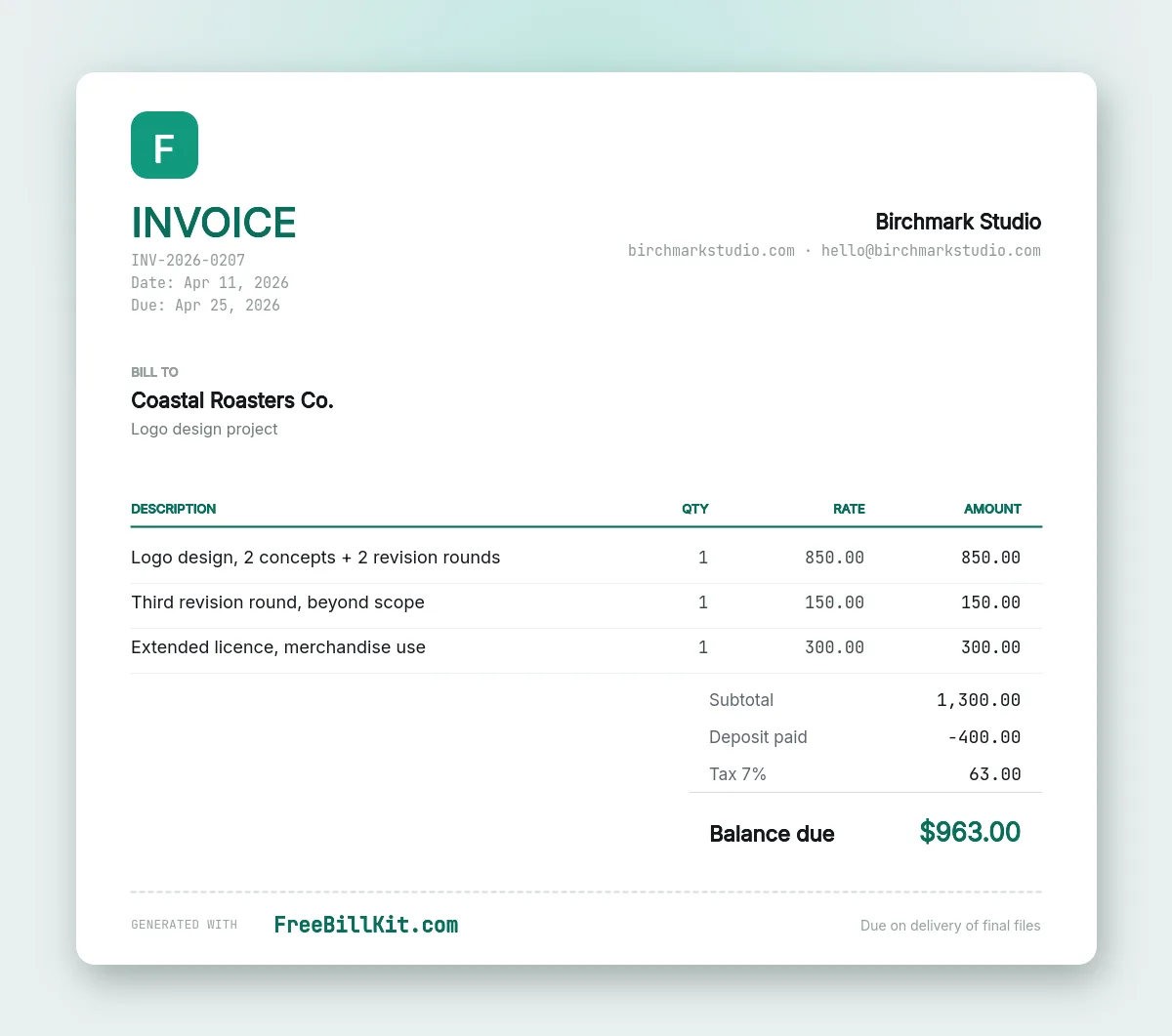
Logo design, two initial concepts and two included revision rounds, $850.00. Third revision round, requested beyond scope, $150.00. Extended licence for use on merchandise, $300.00. Subtotal $1,300.00. Deposit paid on kickoff, -$400.00. Tax at 7%, $63.00. Balance due $963.00.
The licence line matters because a logo delivered for a website is not automatically cleared for print runs or merchandise. Pricing that separately, and naming it on the invoice, protects the fee if the client’s use of the work expands later.
Revisions, and what counts as scope
State the number of revision rounds included in the original quote, in writing, before work starts. A round is normally one consolidated set of feedback addressed in one pass, not unlimited small tweaks over weeks. Once a client understands round three is a paid line rather than an assumed part of the project, most stop asking for round four.
Create a graphic design invoice free
The free invoice generator has these fields ready. Fill it in, preview it, and download the PDF. Nothing is uploaded and there is no account to make.
Related trade templates
- Web design invoice template
- Photography invoice template
- IT consulting invoice template
- All free templates
Frequently asked questions
How many revision rounds should be included?
Two is common for a logo or single asset, more for a full brand identity. State the number in the quote and on the invoice, and price anything beyond it as its own line.
Should licensing be a separate line from the design fee?
Yes, whenever usage matters, a logo for web only versus one cleared for print and merchandise are different rights, and pricing them apart protects the fee if the client’s use expands.
What is a rush fee?
An added charge for compressing the normal turnaround into a shorter window, typically 20 to 50 percent of the design fee, stated as its own line rather than built into a higher base rate.
Why Graphic Designers Need a Different Invoice Template
A standard invoice template has line items for “Product” and “Quantity.” That works if you’re selling t-shirts. It doesn’t work when you’re billing for three logo concepts, two rounds of revisions, and a two-year exclusive license — all on one project.
Squeeze that into a generic template and you get vague line items your client doesn’t understand. Vague line items lead to questions, delays, and the occasional “I didn’t agree to that.”
This template has fields for the things designers actually bill for:
Creative work: Concept development, mood boards, initial directions. Describe what you made, not just hours spent.
Revisions: Space for included rounds plus a separate line for additional revisions at your rate. Clients need to see where “included” ends and “extra” begins.
Files you’ll deliver: List formats separately — print-ready PDF, web PNG/JPG, source files (AI, PSD, Figma). Source files are often a separate charge; make that clear.
Third-party costs: Stock photos, fonts, illustrations you licensed. Pass these through with a small markup or at cost — either way, itemize them.
Usage rights: Exclusive or non-exclusive, how long, where. A line that says “Exclusive license, 2 years, North America” prevents arguments later.
Rush fees: When the timeline compressed and you worked the weekend, that goes on the invoice.
Download the Template
Which format? Choose Word if you want to customize the design. Choose PDF if you want to fill it out and send it as-is.
Download Word Template (.docx)
The Word version works in Word 2016+, Google Docs, and LibreOffice. The PDF has fillable fields and is ready to print.
Filling Out the Template
Your details first. Name or studio, address, email, phone. The Word version has a logo placeholder — click it to replace with your own, or delete it if you don’t have one.
Then the client. Company name, contact person, billing address. Get the billing address right; wrong addresses are a common reason invoices bounce back.
Invoice number and dates. Use a simple sequence: INV-2026-001, INV-2026-002. Include the date you sent it and the date it’s due. Both matter if there’s ever a dispute.
Line items. Be specific. “Logo concept development — 3 initial directions” gets paid faster than “design work.” Your client should be able to match each line to something they approved.
Revisions. Show what was included in the original quote, then list any extras separately.
Licensing terms. One line is enough: “Non-exclusive license, 1 year, worldwide.” Or whatever you agreed.
Totals. Subtotal, tax if applicable, amount due. Check the formulas if you add rows.
Payment terms. “Net 30” means due in 30 days. For projects over $1,000, consider asking for 50% upfront.
Payment Terms Worth Setting
Deposits. For anything over $1,000, ask for 30-50% before you start. This is normal. It also tells you the client is serious.
Milestones. Split large projects: 30% on concept approval, 40% on design delivery, 30% on final files. Invoice at each stage.
Kill fees. If a client cancels halfway, you should be compensated for the time you blocked out. A typical kill fee is 25-50% of the remaining project value. Put it in your contract first.
Late fees. 1.5% per month is standard. Mention it on the invoice — not as a threat, just as a term.
Frequently Asked Questions
What should I put on a graphic design invoice?
Your business info, the client’s billing info, invoice number, dates, and itemized services. For design work, describe deliverables specifically, list revision rounds, note file formats, and state licensing terms.
How do I bill for revisions?
State the included revisions in your quote. On the invoice, list the base fee, then add extra revisions as a separate line item.
Should I charge a deposit?
For projects over $1,000, yes. 30-50% upfront is normal. It covers your initial time and confirms the client is committed.
Do I need to include licensing terms?
It’s smart to. Even one line — “Non-exclusive license, 1 year” — sets expectations. Without it, clients sometimes assume they own everything forever.
What’s the difference between a design invoice and a regular invoice?
A regular invoice lists products or hours. A design invoice needs to describe creative deliverables, revision rounds, file formats, third-party costs, and usage rights.
Do I charge sales tax on design services?
Depends on your state. Some states tax creative services; others only tax physical goods. Check your state’s revenue department or ask an accountant.