Medical Invoice Template
A medical invoice for a private-pay practice lists the date of service, the provider and practice details, a description of each service with its fee, and the amount due. If the patient will claim reimbursement from an insurer, they usually need a superbill: the same document plus provider NPI, tax ID, and the relevant CPT and ICD-10 codes. Build one free below.
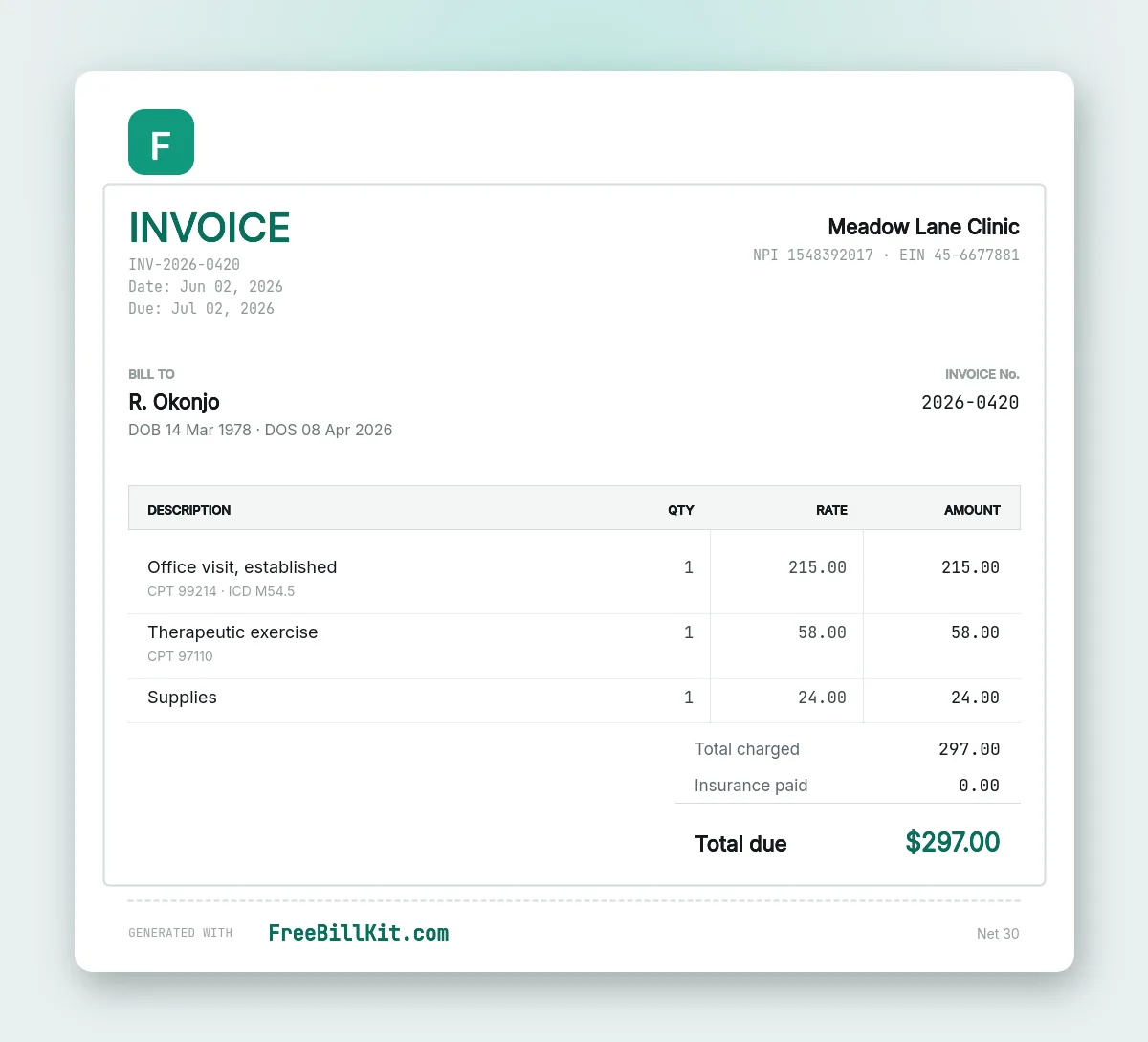
No signup. Fill it in and download the PDF in under a minute.
Most billing software is built for practices that file claims directly with insurers. Plenty of providers do not: cash-pay therapists, private counsellors, wellness and allied health practitioners, and out-of-network clinicians who hand the patient a document and let them claim it back themselves. That last case is the one this page is about.
What goes on a private-pay medical invoice
| Line | What it covers |
|---|---|
| Practice & provider | Practice name, address, provider name and credentials |
| Patient & date of service | Who was seen and when, one line per session or visit |
| Service description | What was provided, with the fee for each |
| Codes (for a superbill) | CPT for the service, ICD-10 for the diagnosis |
| NPI & tax ID | Required by most insurers for reimbursement |
| Payments & balance | Amount paid, method, and anything still outstanding |
Invoice or superbill?
They are close but not identical. An invoice tells the patient what they owe. A superbill is what the patient submits to their insurer to claim money back, and it has to carry more: the provider’s NPI, the practice tax ID, procedure codes and a diagnosis code. If you hand a patient a plain invoice when they needed a superbill, the claim comes back rejected and they return to you for a new document.
The practical answer for most out-of-network providers is to include the extra fields as standard. A patient who does not need them simply ignores them.
A worked example
- Provider: J. Alvarez, LCSW · NPI and practice tax ID shown
- Patient: R. Meyer · date of service 12 August 2026
- Individual therapy, 53 min, CPT 90837: $150.00
- Diagnosis code: ICD-10 as assessed
- Paid at session, card: $150.00
- Balance due $0.00, issued for insurance reimbursement
A note on patient data
Invoices and superbills contain protected health information. Handling that carries obligations under HIPAA and equivalent rules elsewhere, in particular around how documents are stored and transmitted, since ordinary email is not a secure channel. Our generator runs entirely in your browser and uploads nothing, but you remain responsible for how you store and send the file afterwards. If you are unsure what applies to your practice, check with your compliance advisor.
Create a medical invoice free
Add your practice details, services and codes, then download a clean PDF. No account, no watermark, nothing uploaded.
Prefer an editable file? The free invoice template comes in Word, Excel and PDF. Taking payment at the visit? The receipt template covers proof of payment.
Related templates
Frequently asked questions
What is the difference between a medical invoice and a superbill?
An invoice tells the patient what they owe. A superbill is the document a patient submits to their insurer to seek reimbursement, and it must carry additional detail: the provider’s NPI, the practice tax ID, CPT procedure codes and an ICD-10 diagnosis code. Out-of-network providers usually issue superbills rather than plain invoices.
Do I need CPT and ICD-10 codes on the invoice?
Only if the patient intends to claim reimbursement. For straightforward cash-pay services where no insurance is involved, a clear description of the service and the fee is enough. If in doubt, include the codes. A patient who does not need them can ignore them, whereas a missing code means the claim is rejected.
Is it safe to email a medical invoice to a patient?
Ordinary email is not a secure channel, and these documents contain protected health information. Many practices use a patient portal or an encrypted delivery method instead. What applies to you depends on your jurisdiction and practice type, so confirm with your compliance advisor rather than assuming.