Free Receipt Template (Word & PDF)
A receipt template gives you a clean, professional way to confirm every payment you receive. It records who paid, how much, what for, and when: the four facts that settle most payment questions before they start. Landlords, freelancers, shop owners, and service businesses all rely on receipts as daily proof of payment.
On this page you get a free receipt template two ways. Download the Word or PDF file below, or use the online generator to create one in about a minute. This page also works as a hub: below you will find 30+ specialized receipt templates for everything from rent to restaurant bills. Further down you will find what every receipt must include, how a receipt differs from an invoice, and answers to the questions businesses ask most.
Everything here is free. There is no signup and no watermark.
Table of Contents
Download the receipt template
Choose the format that suits you. The Word file stays editable for adding your business details. The PDF is print-ready. The general template above suits most payments. For specialized needs, see the type-specific templates below.
⇩ Receipt template – Word (.docx)
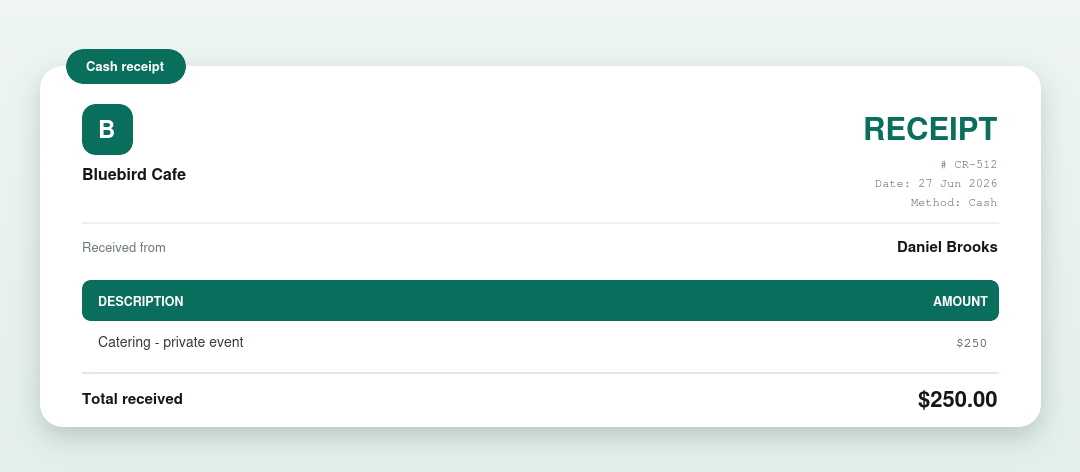
Create a receipt online with this receipt template
Enter the payer, amount, payment details, and date. The generator formats everything into a clean PDF you can download immediately. It works on phones, tablets, and desktops. Need a specific type? The generator also covers cash receipts and rent receipts.
What is a receipt
A receipt is a written acknowledgment that a payment was received. It is issued after payment, which is what distinguishes it from an invoice. The receipt closes the loop: the buyer has proof they paid, and the seller has a record of the income.
Receipts matter more than most businesses realize. They are the first document requested in a payment dispute, the proof customers need for returns and warranties, and a core part of the records tax authorities expect you to keep. The IRS, for example, expects businesses to keep supporting documents for income and expenses (see the IRS record-keeping guidance). A one-page template makes every receipt consistent and complete.
What your receipt template must include
A receipt missing key details fails at the one job it has: proving the payment happened. Include all eight of these:
- The word RECEIPT printed clearly at the top.
- Unique receipt number and date of payment.
- Your business name, address, and contact details.
- Payer name.
- Description of what the payment was for.
- Amount paid, in figures and words for larger sums.
- Payment method: cash, card, bank transfer, or check.
- Signature or authorized name, confirming receipt.
Receipt template format
A standard layout looks like this:
RECEIPT No. R-0042
From: [Your Business Name, Address]
Received from: [Payer Name]
Date: [Payment date] | Payment method: [Cash/Card/Transfer]
Description | Amount
[Item or service] | [Amount]
TOTAL RECEIVED: [Amount]
Amount in words: [Amount in words]
Received by: [Name + Signature]
Keep receipts numbered in sequence. Matching numbers to your records takes seconds when every receipt follows the same format.
Receipt templates by type
The general template above suits most payments. These are the versions where the document has to carry something extra, either because a tax authority asks for it or because whoever receives it will not accept a bare total.
- Cash receipt template, for payments with no bank record behind them
- Rent receipt template, with period covered and balance
- Deposit receipt template, for a security deposit held against damage
- Itemized receipt template, line by line with quantity and unit price
- Restaurant receipt template, food and drink, tax and tip
- Gas receipt template, gallons, price per gallon and pump
- Taxi receipt template, fare, route, tolls and surcharges
- Daycare receipt template, with provider tax ID for childcare claims
- Car rental receipt template, rate, insurance, fuel and tolls
- Airbnb receipt template, nightly rate, cleaning fee and occupancy tax
- Donation receipt template, for registered charities
- Refund receipt template, for money returned to a customer
- Hotel receipt template, folio with nightly rates and city tax
- Parking receipt template, entry and exit times with the tariff
- Oil change receipt template, odometer, oil grade and next service due
- Car wash receipt template, package and extras
- Medical receipt template, with codes for insurance, HSA and FSA
- Dental receipt template, CDT codes and tooth numbers
- Sales receipt template, goods sold with serial numbers and return terms
- Gift receipt template, proof of purchase with no price shown
- Towing receipt template, hook-up, mileage, winching and storage
- Car sale receipt template, VIN, odometer and sold as seen
- Grocery store receipt template, weighed items and per line tax codes
- Credit card receipt template, the card slip with auth code and last four
- Pharmacy receipt template, Rx number, NDC and copay for HSA and FSA claims
- POS receipt template, register, cashier, voids and split tender
- Coffee shop receipt template, sizes, customisations and loyalty
- Bar receipt template, timestamped rounds and pre-authorisation
- Shipping receipt template, tracking, dimensional weight and insurance
- Toll receipt template, plazas, transponder and axle class
Receipt vs invoice
These two are often confused but serve opposite moments:
| Receipt | Invoice | |
|---|---|---|
| Purpose | Confirms payment received | Requests payment |
| Timing | After payment | Before payment |
| Issued by | Seller to buyer | Seller to buyer |
| Shows | Amount paid, date, method | Amount owed, due date |
| Legal role | Proof of payment | Payment obligation |
| Next step | Filed by both sides | Buyer pays, then gets a receipt |
An invoice asks for money. A receipt confirms it arrived. Every completed sale produces both, in that order.
When to use this receipt template
Cash payments. With no bank record behind them, cash needs written proof most.
Rent collection. Landlords document each payment with the period covered.
Service businesses. Freelancers and trades confirm client payments on the spot.
Retail and food. Shops and restaurants hand a receipt with every sale.
Donations. Charities issue receipts donors need for tax records.
Mistakes that cause problems
No receipt number. Without one, finding a specific payment in your records is painful. Number every receipt.
Missing payment method. “Paid” is not enough. Record whether it was cash, card, or transfer. Disputes turn on this detail.
Vague descriptions. “Services” tells nobody anything. Write what the payment was for.
No signature. An unsigned receipt is just a piece of paper. Sign or stamp it.
Skipping receipts for small amounts. Small payments add up, and tax records need them all. Issue one every time.
Receipt template FAQs
Is this receipt template really free?
Yes. Download the Word or PDF file free, or generate as many receipts as you need with the online tool. No signup, no payment, no watermark, and no download limits.
How do I write a receipt?
Put the word Receipt and a number at the top, then name who issued it and who paid. Add what the payment was for, the amount, the date, and the payment method, and leave a signature line. The template above has those fields already laid out.
What is the difference between a receipt and an invoice?
An invoice requests payment before it is paid; a receipt confirms payment was received after the fact. The invoice comes first, the receipt follows once money changes hands.
Can I use this receipt template for cash payments?
Yes. It works for cash, card, or bank transfer. For a dedicated version, use the cash receipt template.
What should a receipt include?
The word Receipt, a unique number, date, your business details, payer name, description of the payment, amount, payment method, and a signature. All eight are covered in the checklist above.
Do I need to give a receipt for every payment?
It is good practice. Receipts protect both sides in disputes and form part of the records tax authorities expect. Issue one every time money changes hands.
Is a handwritten receipt valid?
Yes, if it contains the key details: who paid whom, how much, for what, when, and a signature. A printed template just makes it consistent and professional.
How long should I keep receipts?
Keep them with your tax records for the full retention period, typically six to seven years. File by receipt number or date for easy retrieval.
Can I email a receipt instead of printing it?
Yes. A PDF receipt sent by email is standard practice and widely accepted. The generator produces a PDF ready to send.
What is the difference between a receipt and a sales slip?
A sales slip is a type of receipt, usually from a register, summarizing a retail sale. A receipt is the broader term covering any written payment confirmation.
Related templates
- Receipt Generator: create one online in about a minute
- Cash Receipt Template: for payments with no bank record
- Rent Receipt Template: with period covered and balance
- Invoice Generator: bill before payment arrives