Moving Company Invoice Template
A moving invoice bills crew and truck by the hour for local moves, or by weight and distance for long-distance ones. Add packing materials, and any accessorials such as stairs, long carry, shuttle or bulky items. State the valuation coverage the customer selected. It is not the same as insurance. Build one free below.
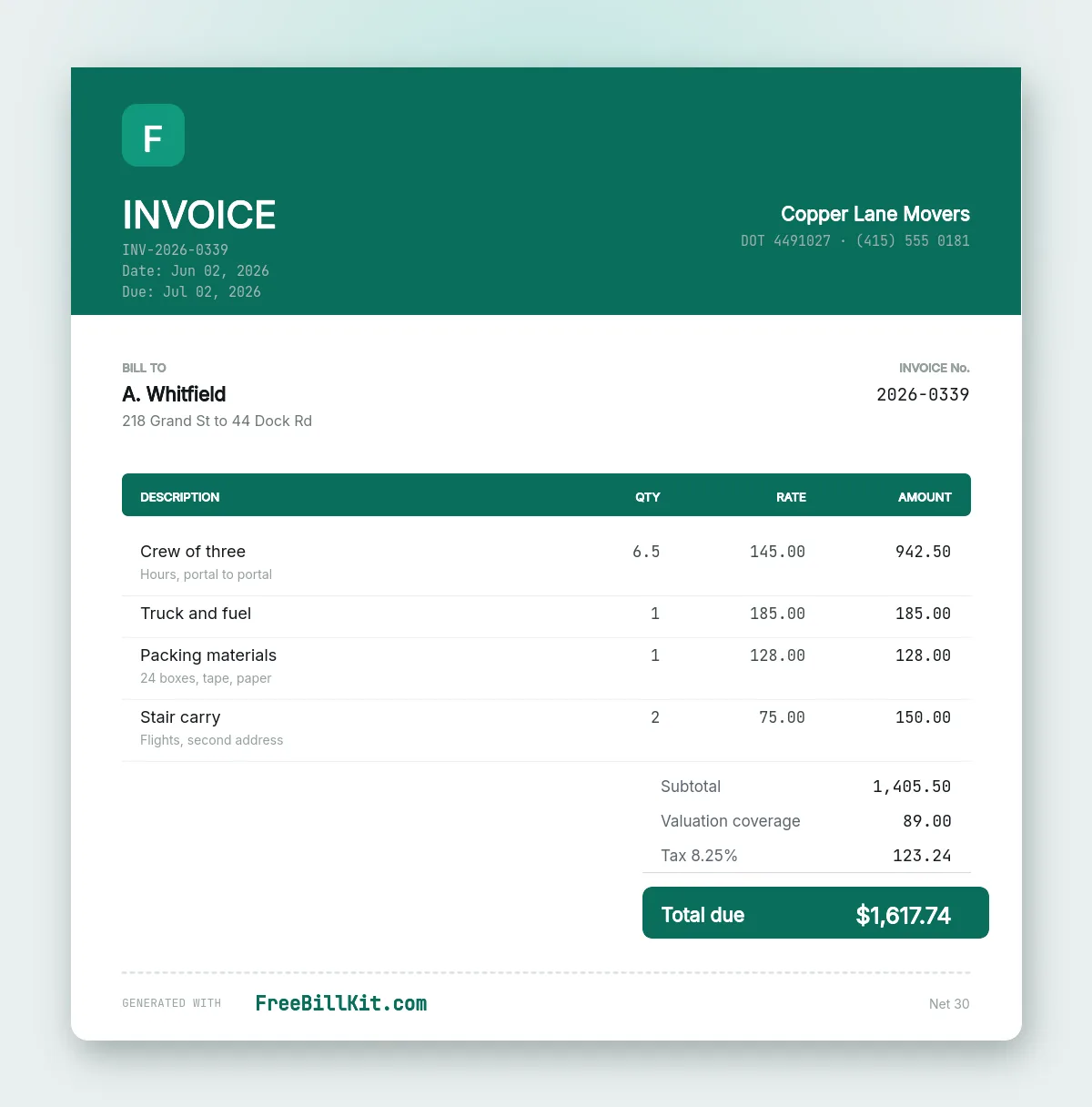
No signup. Fill it in and download the PDF in under a minute.
Moving companies bill two completely different ways depending on distance, and customers rarely know which applies to them. Local moves are hourly: crew size, truck, travel time. Long-distance moves are priced on shipment weight and mileage. The invoice that causes complaints is the one that does not say which model was used, or that introduces accessorial charges the customer first hears about on moving day.
What goes on a moving invoice
| Line | What it covers |
|---|---|
| Crew & truck | Number of movers × hours × rate, plus truck charge |
| Travel time | Depot-to-origin and destination-to-depot, if charged |
| Weight & mileage | For long-distance moves instead of hourly |
| Packing materials | Boxes, wrap, tape, mattress bags, by quantity |
| Accessorials | Stairs, long carry, shuttle, bulky item, storage |
| Valuation coverage | Which level the customer selected, and what it covers |
A worked example
A local two-bedroom move billed hourly:
- 3 movers × 6.5 hrs @ $45.00/hr per mover: $877.50
- Truck charge: $150.00
- Travel time, 1.0 hr: $135.00
- Packing materials: 18 boxes, wrap, tape: $142.00
- Stair carry, 2nd floor at destination, no elevator: $75.00
- Valuation: released value, $0.60/lb per article (customer selected)
- Subtotal $1,379.50 · tax as applicable · due on delivery
The stair charge is listed with the reason. Accessorials that appear as bare numbers look invented; the same charge with “2nd floor, no elevator” beside it is simply a fact about the job.
What causes moving invoice disputes
- Accessorials without an explanation. Long carry, shuttle and stairs should each say why they applied.
- Valuation confused with insurance. Released value coverage is a liability limit, not an insurance policy. State which level the customer chose.
- Travel time not disclosed. If you bill depot-to-depot, it belongs on the estimate as well as the invoice.
- Materials with no counts. Boxes and wrap add up; listing quantities makes the figure checkable.
Create a moving invoice free
Enter crew hours, truck, materials and accessorials, watch the total build, and download a clean PDF. No account, no watermark.
Quoting the move first? The quote and estimate generator is where accessorials and valuation should be set out. Paid on delivery? The cash receipt generator gives immediate proof.
Related templates
- Trucking invoice template
- Delivery note template
- House cleaning invoice template
- All templates · Quote vs estimate vs invoice
Frequently asked questions
Should a moving invoice be hourly or by weight?
Local moves are usually billed hourly by crew size and truck, while long-distance moves are priced on shipment weight and mileage. Either is standard. The invoice simply needs to state which model applied, since customers often assume the other one.
What are accessorial charges?
They are extras beyond the basic move: stair carries, long carries where the truck cannot park close, shuttle vehicles for inaccessible streets, bulky items like pianos, and storage. Each should appear as its own line with a short note explaining why it applied.
Is valuation coverage the same as insurance?
No. Valuation is the moving company’s limit of liability for loss or damage, and released value coverage in particular pays a fixed amount per pound rather than replacement cost. It is not an insurance policy, so the invoice should record which level the customer selected.