Musician Invoice Template
Musicians lose money when a gig invoice leaves out the deposit, the overtime rate or the cancellation terms. A good musician invoice shows the event date, set lengths, base fee, extras, travel, deposit credited, tax and balance due. Create one free below with no signup, then download the PDF.
Bands complicate an invoice a solo act does not have to deal with: one client, one fee, but the money often needs splitting between members afterward. The invoice should still read as a single, clean bill.
What goes on a musician invoice
- Your name or band name, and contact details
- Client name and event date
- Invoice number and issue date
- Base performance fee, with the number of sets or hours it covers
- Number of musicians included in the fee, if it varies by lineup
- Additional set or extended playing time, billed separately
- Rehearsal time, if billed rather than included
- Travel or mileage beyond a stated radius
- Deposit already paid, credited against the total
- Tax, total, and balance due
A worked example
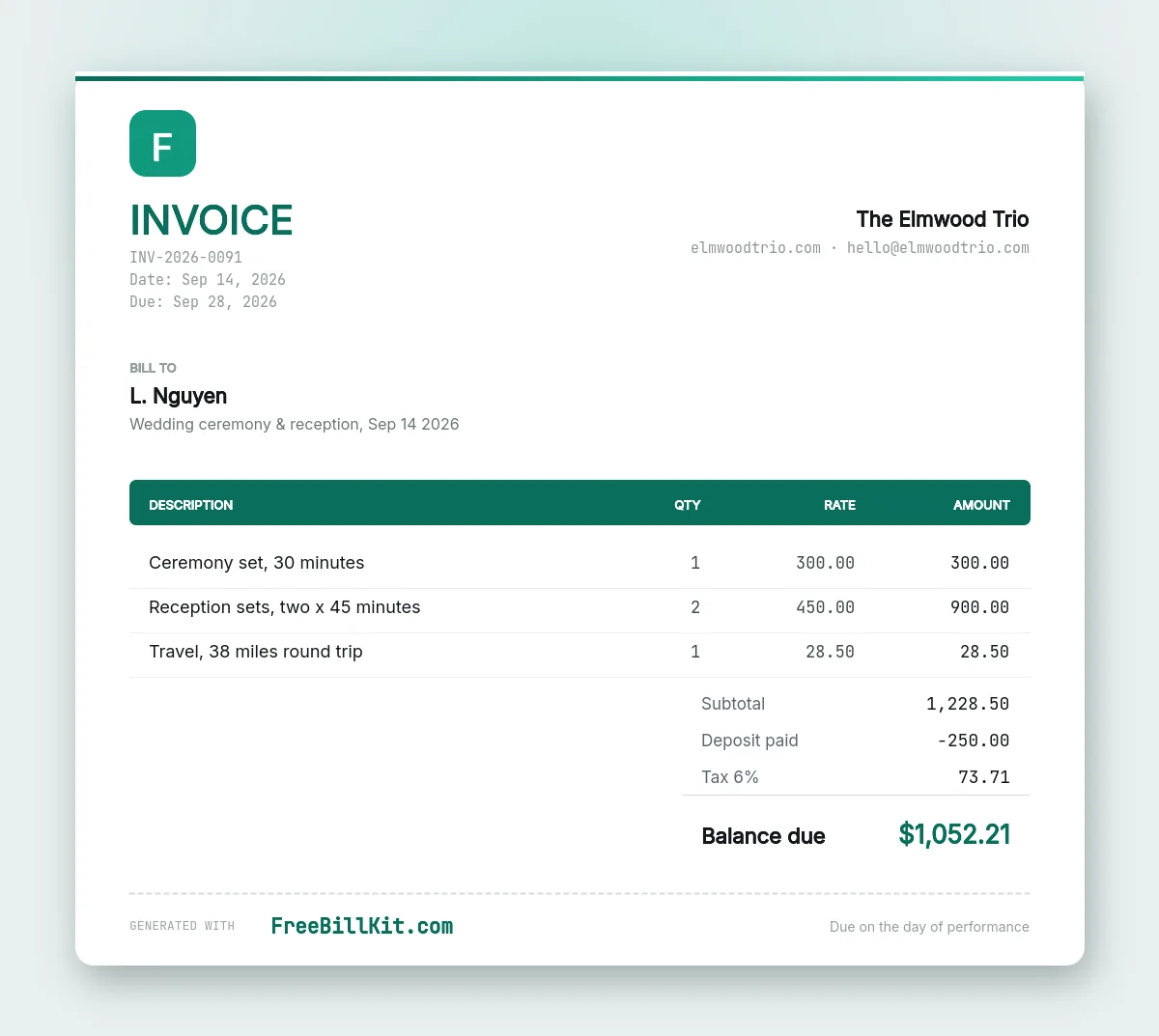
Wedding ceremony and reception, string trio, 14 September. Ceremony set, 30 minutes, $300.00. Reception sets, two sets of 45 minutes, $900.00. Travel, 38 miles round trip at $0.75, $28.50. Subtotal $1,228.50. Deposit paid, -$250.00. Tax at 6%, $73.71. Balance due $1,052.21.
Splitting the ceremony fee from the reception sets matters when a couple books one and not the other, or adds the ceremony after the reception was already quoted.
Billing as a band without arguing over the split
Issue one invoice to the client for the full fee, then handle the division between members separately, whether that is equal shares or weighted by who arranged the booking. Trying to itemise each musician’s cut on the client-facing invoice makes it longer and gives the client a reason to negotiate down an individual’s share rather than the whole fee.
Create a musician invoice free
The free invoice generator has these fields ready. Fill it in, preview it, and download the PDF. Nothing is uploaded and there is no account to make.
Related trade templates
Last updated October 2026. General guidance for working musicians, not tax or legal advice. Sales tax and income reporting rules vary by country and state.
What changes between a private client, a venue and an agency?
| Client | Usually pays | Watch for |
|---|---|---|
| Private client (wedding, party) | A deposit to hold the date, the balance before or on the day | Cancellation terms, set lengths and travel |
| Venue or promoter | The agreed fee, often after the night, sometimes on net terms | Payment timing, door deals and who supplies the PA |
| Agency or corporate client | On net terms such as Net 30, after a purchase order | Purchase order numbers, vendor forms and slower payment |
Corporate clients often need a purchase order number on the invoice and pay on terms. See what Net 30 means before you agree to it.
How much deposit should you ask for, and what should it cover?
There is no single rule, but many working acts ask for 25% to 50% of the fee to hold a date. Write down what the deposit secures and what happens to it if the client cancels. State the balance due date on the invoice, for example 14 days before the event, so you are not chasing money on the night.
What should a cancellation policy say?
- The date after which the deposit is not refunded.
- The share of the fee due if the client cancels close to the event.
- What happens if the event is moved to another date.
- What happens if bad weather affects an outdoor event.
- What happens if you have to cancel, for example illness, and whether you will send a replacement.
Put the policy in your booking agreement and repeat the key points on the invoice.
A second example: a pub gig
Two 45-minute sets for a duo on a Friday night, agreed fee $400. PA and lighting hire $60. Subtotal $460. No deposit taken. Payment due on the night, receipt issued on payment. Terms: fee payable at the end of the second set.
A third example: a session musician
| Description | Hours | Rate | Amount |
|---|---|---|---|
| Session guitar, studio recording | 4 | $75.00 | $300.00 |
| Overtime beyond the booked hours | 1 | $112.50 | $112.50 |
| Subtotal and total due | $412.50 |
Payment terms: Net 15. Overtime is charged at 1.5 times the hourly rate, as agreed in the booking message. Write the overtime rate down before the session starts.
What does not belong on a gig invoice?
Royalties for performing or recording your own songs are normally collected through performing rights organisations and publishers, not billed to the client who booked the gig. Keep the invoice to your fee, your costs and any agreed extras. If a venue pays cash on the night, give a written receipt. The cash receipt generator can do that.
Which musician invoice mistakes cost money?
- No event date, venue or set length, so the fee cannot be matched to the booking.
- No overtime rate, so a long night is free.
- The deposit not credited on the invoice, which leads to a double payment query.
- Travel, parking and equipment hire left off because they were forgotten.
- Agreeing to be paid on the night with nothing written down.
- No cancellation terms, so a late cancellation leaves you out of pocket.
Related trade templates: DJ invoice template, photography invoice template and catering invoice template. See a general invoice example or read how to write an invoice.
Frequently asked questions
How should a band split invoice payment among members?
Bill the client as one invoice for the full fee, then divide the money between members separately, by an agreed formula. Keep that division off the client-facing document.
Should rehearsal time be on the invoice?
Only if you charge for it. Many acts fold rehearsal into the performance fee for standard material and bill separately only for a first look at unusual or original material.
What if the gig runs long?
State an extra-set or per-hour rate on the invoice, calculated the same way as the base fee, rather than absorbing the extra time or negotiating a number after the fact.
How do I write an invoice for a musician?
Add your name or band name, the client and event date, an invoice number and date, the performance fee with the set lengths, any extras such as travel or equipment, the deposit already paid, the total and the due date.
How much deposit should a musician ask for?
Many acts ask for 25% to 50% of the fee to hold the date. State what the deposit secures and what happens to it if the client cancels.
Can I invoice a venue for a gig?
Yes. Invoice the venue or promoter for the agreed fee and any agreed extras, state the payment terms, and include the date and set details so the invoice matches the booking.
Can ChatGPT create an invoice for a musician?
A chatbot can draft wording, but a form-based generator keeps the layout and totals correct. Check every figure against your booking before you send it.