UK Invoice Template: Requirements & Free Generator
An invoice that leaves out the VAT number, the sequence number or the right VAT breakdown can be rejected by a business customer and cause trouble with HMRC. A UK invoice should show the word invoice, a unique sequential number, your details, the customer, the date, a clear description and the total, plus VAT details if you are registered. Create one free below in GBP, no signup, and download the PDF.
No signup. Fill it in and download the PDF in under a minute.
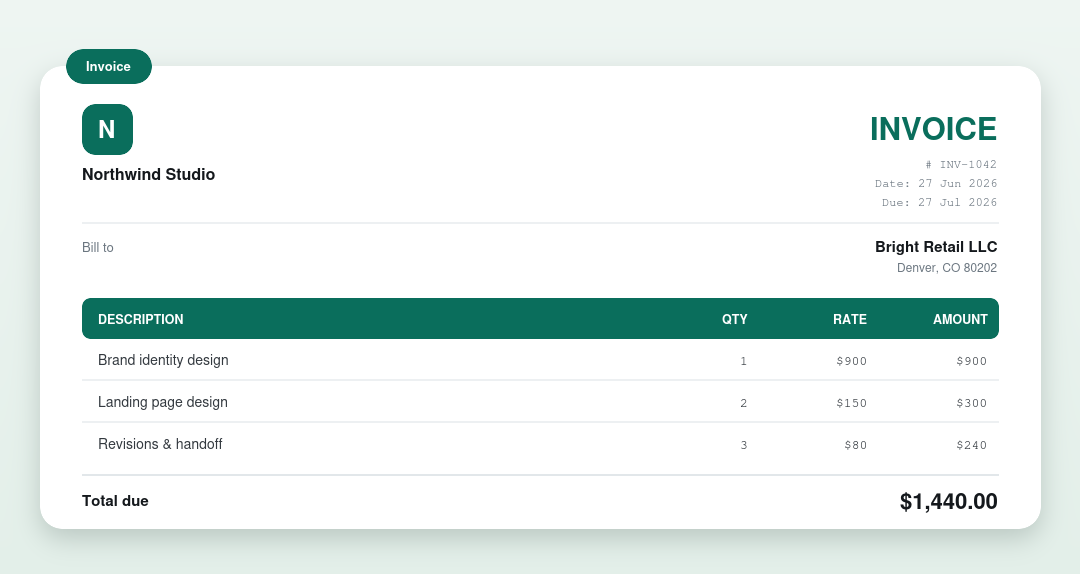
What a UK invoice must include
| Must include | Detail |
|---|---|
| The word “Invoice” | Plus a unique, sequential invoice number |
| Your business | Name and address (a limited company must use its registered name) |
| The customer | Name and address you’re billing |
| Dates | The invoice date (and supply date if different) |
| Line items | A clear description, quantity and price for each |
| Totals | The total owed; if VAT-registered, the VAT rate and amount too |
| VAT number | Required only if you are VAT-registered |
VAT: when you actually need it
You only charge and show VAT if your business is VAT-registered. Registration is compulsory once your VAT-taxable turnover passes the threshold (currently £90,000 in a 12-month period); below that it’s optional. The standard VAT rate is 20%. If you’re not registered, don’t show or charge VAT and don’t put a VAT number on the invoice.
Sole trader vs limited company
A sole trader can invoice under their own name or a trading name. A limited company must show its full registered company name; showing the company registration number is good practice. Both need the core fields above.
Create your UK invoice free
Our free invoice generator runs in your browser: set the currency to GBP (£), add your details and items, and download a clean PDF. No signup, no watermark. Prefer a file? Grab a free invoice template, or see an invoice example.
Invoicing in another country?
This is general information, not tax or legal advice. Rules and thresholds change, so confirm the current requirements with GOV.UK / HMRC.
Last updated October 2026. General information, not tax or legal advice. VAT thresholds, rates and rules change, so confirm the current position with GOV.UK or HMRC.
What must a VAT invoice show?
A VAT-registered business must put these details on a VAT invoice. HMRC lists them in its guidance on what an invoice must include.
| Detail | What to write |
|---|---|
| Unique, sequential number | For example INV-2026-014, with no gaps or duplicates |
| Your name, address and VAT number | A limited company uses its registered name |
| Invoice date | The date you issue it |
| Date of supply | The tax point, if it differs from the invoice date |
| Customer name and address | Who you are billing |
| Description of the goods or services | Clear enough to identify what was supplied |
| Quantity and price | Per line, with any discount shown |
| VAT rate for each item | Standard, reduced or zero rate |
| Total excluding VAT | Before tax |
| Total VAT payable, in pounds sterling | Even if the invoice is in another currency |
| Total amount payable | Including VAT |
HMRC expects you to issue a VAT invoice within 30 days of the date of supply, so check its current guidance for any exceptions.
Which VAT rates apply?
| Rate | Examples | What to show |
|---|---|---|
| Standard, 20% | Most goods and services | The rate and the VAT amount |
| Reduced, 5% | Home energy and a few other items | The rate and the VAT amount |
| Zero, 0% | Most food, books and children’s clothes | The 0% rate, since the sale is still recorded |
| Exempt | Insurance, some education and health services | No VAT, and mark the line as exempt |
These are examples only. Check the rate for what you sell on GOV.UK.
What does an invoice look like for a VAT-registered sole trader?
The business, customer and VAT number are made up for illustration.
| Detail | Example |
|---|---|
| From | Calder Creative, 12 Mill Lane, Leeds LS1 4AB |
| VAT number | GB 123 4567 89 |
| Bill to | Hartley Foods Ltd, 8 Station Road, York YO1 6HT |
| Invoice number and date | INV-2026-014, 1 October 2026 |
| Payment terms | 30 days, due 31 October 2026 |
| Description | Qty | Unit price | VAT rate | Amount |
|---|---|---|---|---|
| Brand design | 1 | £600.00 | 20% | £600.00 |
| Website hosting, one year | 1 | £120.00 | 20% | £120.00 |
| Total excluding VAT | £720.00 | |||
| VAT at 20% | £144.00 | |||
| Total payable | £864.00 |
What changes if you are not VAT-registered?
Leave VAT off entirely: no VAT line, no VAT number and no VAT rate. You do not have to write that you are not registered, but you must not charge VAT or show a VAT number. A non-VAT invoice follows the same layout as the example above, with the total simply equal to the sum of the lines. If you register later, switch to the VAT layout from the date your registration takes effect.
What details does a limited company put on an invoice?
A limited company uses its full registered name. Companies House rules also require the registered number and registered office address on business letters, order forms and websites, and most companies print them on invoices too. Sole traders can invoice under their own name or a trading name.
What are your rights if a business customer pays late?
For business-to-business debts, UK law allows you to charge statutory interest at 8% above the Bank of England base rate, plus a fixed sum: £40 for debts under £1,000, £70 for debts from £1,000 to £9,999.99 and £100 for £10,000 or more. If you have not agreed payment terms, interest generally starts after 30 days. You can agree your own terms in writing, but they must be fair. See what Net 30 means and how to collect an unpaid invoice calmly.
Do you need to show VAT in sterling on a foreign currency invoice?
Yes. If you invoice in euros or dollars, HMRC requires the total VAT payable to be shown in pounds sterling. The simplest approach is to show the exchange rate you used and the VAT amount in pounds underneath the invoice total.
How long should you keep UK invoices?
VAT records, including copies of invoices you issue and receive, must generally be kept for six years. VAT-registered businesses must also keep digital records and submit returns through Making Tax Digital compatible software. Ask your accountant how this applies to you.
Which UK invoice mistakes cause trouble?
- Showing a VAT number or charging VAT when you are not registered.
- Breaking the invoice number sequence.
- Showing a single VAT amount when items have different rates.
- Leaving out the date of supply when it differs from the invoice date.
- Showing VAT in euros or dollars rather than sterling.
- A limited company invoicing under a trading name only.
New to invoicing? Read how to write an invoice, see an invoice example or compare an invoice with a receipt in invoice vs receipt. Need to price a job first? Use the quote template.
Frequently asked questions
What is a VAT invoice?
A VAT invoice is an invoice issued by a VAT-registered business that shows the VAT charged separately from the price of the goods or services, along with the seller’s VAT registration number. A VAT-registered buyer needs it to reclaim the VAT on their own return.
Do I need to be VAT-registered to send an invoice?
No. You can invoice as a sole trader or company without VAT registration. You only register (and add VAT) once your turnover passes the threshold, or if you choose to voluntarily.
Do I have to show VAT on my invoice?
Only if you’re VAT-registered. Then you show your VAT number and the VAT rate and amount. If you’re not registered, leave VAT off entirely.
What is the UK VAT rate?
The standard rate is 20%. Some goods and services are reduced-rate (5%) or zero-rated, and some are exempt.
Do UK invoices need an invoice number?
Yes. Every invoice needs a unique number that follows a sequence, so your records reconcile and nothing is duplicated.
What must a UK invoice include?
The word invoice, a unique sequential number, your name and address, the customer name and address, the invoice date and a clear description of what is supplied. If you are VAT-registered, also your VAT number, the date of supply, the VAT rate for each item and the VAT amount in sterling.
How do I create a UK invoice?
Add your business details and the customer details, a sequential invoice number and the date, list each item with quantity and price, and add VAT only if you are registered. Then show the total and the payment terms.
What is the late payment interest rate on UK invoices?
For business-to-business debts, statutory interest is 8% above the Bank of England base rate, plus a fixed sum of 40, 70 or 100 pounds depending on the size of the debt.
How long do I keep invoices in the UK?
VAT records, including invoices issued and received, must generally be kept for six years. Ask your accountant about other records.
Can ChatGPT generate an invoice?
A chatbot can draft the wording, but a form-based generator keeps the layout and totals correct. Check every figure, the VAT number and the sequence number before you send it.
Written by the FreeBillKit team. Last reviewed October 2026.