Free Credit Note Template
A credit note, also called a credit memo in the US, is a document a seller issues to reduce or cancel an amount on an invoice already sent. Returns, overcharges, and post-sale discounts are the usual reasons. Because a finalized invoice should never be edited or deleted, the credit note is the correct way to adjust it while keeping a clean audit trail.
On this page you get a free credit note template two ways. Download the Word or PDF file below and fill it in yourself, or use the online generator to create one in about a minute. Further down you will find what every credit note must include, how it differs from a debit note, and answers to the questions sellers ask most.
Everything here is free. There is no signup and no watermark.
Download the credit note template
Choose the format that suits you. The Word file is editable, so you can add your logo and adjust the layout. The PDF is print-ready. Both are free with no signup. Both files use the same clean credit note template layout.
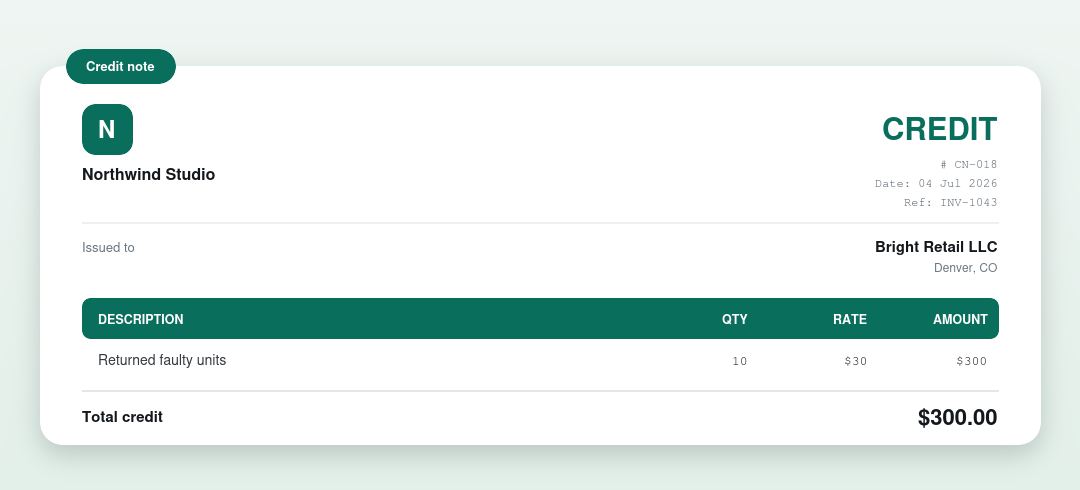
Prefer to skip the files? The free credit note template generator below fills everything in for you.
Create a credit note online
Enter your business details, the customer, the original invoice number, and the amounts being credited. The generator formats everything into a clean PDF you can download immediately. It works on phones, tablets, and desktops, and every credit note template it produces is print-ready.
What is a credit note
A credit note tells the buyer they owe less than the original invoice stated. The seller issues it after the invoice is finalized, which is exactly when editing the invoice itself stops being an option. Sequential invoice numbering exists so tax authorities can trace every sale, and changing a sent invoice breaks that trail.
Typical situations include a customer returning goods, an overcharge or pricing error on the invoice, damaged items arriving in transit, a service that did not meet the agreed terms, or a discount negotiated after the invoice went out. In each case the credit note template records what changed and why.
The credit can work two ways. Either the seller refunds the money, or the amount stays as credit against the customer’s next invoice. State which one applies on the note itself. The credit note template further down includes a field for the refund method.
What your credit note template must include
A credit note missing key details can be rejected by the buyer’s accounts team or questioned in an audit. Make sure your credit note template includes all eight of these:
- The words “Credit Note” printed clearly at the top, plus a unique credit note number.
- Issue date of the credit note.
- Seller name, address, and contact details.
- Buyer name and address.
- Original invoice number the credit relates to, with its date.
- Itemized list of the goods or services being credited, with quantities and amounts.
- Total credit amount, with tax adjusted in the same proportion as the original invoice.
- Reason for the credit, such as return, overcharge, or discount, and whether it is a refund or credit against a future invoice.
Credit note template format
A standard layout looks like this:
CREDIT NOTE No. CN-0042
From: [Seller Name, Address]
To: [Buyer Name, Address]
Date: [Issue date]
Against invoice: [Original invoice number, dated]
Item | Qty | Amount
[Item 1] | [Qty] | [Amount]
[Item 2] | [Qty] | [Amount]
Subtotal credited: [Amount]
Tax adjustment: [Amount]
TOTAL CREDIT: [Amount]
Reason: [Return / Overcharge / Discount]
Refund method: [Cash refund / Credit to next invoice]
Keep your credit note template to one page when possible. Always reference the original invoice number so the two documents link together in your records.
Credit note vs debit note
These two get confused constantly.
| Credit note | Debit note | |
|---|---|---|
| Issued by | Seller to buyer | Buyer to seller (or seller to buyer for undercharge) |
| Effect | Reduces what buyer owes | Increases what buyer owes |
| Common use | Returns, overcharges, discounts | Undercharges, returned credit notes |
| Tax effect | Reduces reported tax | Increases reported tax |
| Linked to | Original sales invoice | Original purchase invoice or credit note |
If you overcharged, you issue a credit note. If you undercharged and need to bill more, that is a debit note.
When to issue a credit note
Goods returned. A customer sends products back. The credit note documents the return and the refund or account credit.
Overcharge or pricing error. The invoice went out with the wrong price. Rather than editing it, issue a credit note for the difference.
Damaged in transit. Items arrived broken. The credit note records the agreed compensation.
Service shortfall. The work did not match the agreed scope. A partial credit note settles the dispute without reissuing the invoice.
Post-sale discount. You agreed a discount after invoicing. The credit note applies it cleanly.
Cancelled orders. Part of an order was cancelled after invoicing. Credit the cancelled lines.
Each of these situations is simple to document with the free credit note template at the top of this page.
Tax treatment of credit notes
A credit note usually reverses the tax on the credited portion. If you charged VAT or GST on the original invoice, your credit note template should show the same tax rate applied to the credited amount, so your tax records stay consistent.
Keep every credit note numbered and filed with the original invoice. Tax authorities in the US, UK, and EU all expect credit notes to be traceable to the invoice they adjust. UK VAT rules require VAT credit notes to show the same details as the original VAT invoice (see GOV.UK guidance on VAT record keeping).
Never use a credit note to hide a sale. It is an adjustment document, not a way to make revenue disappear.
Mistakes that cause problems
Avoid these five mistakes when you fill out your credit note template:
Editing the original invoice instead. Invoices carry sequential numbers for a reason. Change the number trail and you create an audit problem. Always issue a separate credit note.
Forgetting the original invoice number. A credit note that does not reference its invoice is hard to match in anyone’s books. Print the number and date on every copy.
Skipping the tax adjustment. Crediting the net amount but leaving the tax untouched misstates both your records and the buyer’s. Adjust tax in proportion.
Reusing credit note numbers. Each credit note needs its own unique number, just like invoices. Duplicates suggest sloppy records.
No reason stated. “Credit” with no explanation invites questions from accountants and auditors alike. One line on the reason is enough.
Credit note template FAQs
Is this credit note template really free?
Yes. Download the Word or PDF file free, or generate as many credit notes as you need with the online tool. No signup, no payment, no watermark, and no download limits.
What is a credit memo? Is it the same as a credit note?
Yes, same document. American businesses tend to say credit memo while British and Commonwealth businesses say credit note. Both reduce what a customer owes on an invoice already sent.
Is a credit invoice the same as a credit note?
Yes. Credit invoice is another name for the same document, commonly used in some accounting systems. It reduces or cancels an amount on a previously issued sales invoice.
Why can I not just edit the original invoice?
Because invoices use sequential numbering that tax authorities rely on to trace sales. Editing or deleting a sent invoice breaks that audit trail. A separate credit note keeps your records clean and compliant.
Does a credit note reverse the tax too?
Usually yes. Crediting part of an invoice also reverses the tax on that portion at the same rate. Your credit note should show the tax adjustment as its own line.
What is the difference between a credit note and a debit note?
A credit note reduces what the buyer owes, issued by the seller for returns or overcharges. A debit note increases what the buyer owes, typically for undercharges. They move the balance in opposite directions.
Should a credit note have its own number series?
Yes. Number credit notes separately from your sales invoices, for example CN-0001 onward. Mixing them into the invoice sequence creates confusion in your books.
Can a credit note be issued before the invoice?
No. A credit note adjusts an existing invoice, so the invoice comes first. If no invoice was sent yet, simply correct the quote or the draft invoice instead.
How long should I keep credit notes?
Keep them as long as you keep the invoices they adjust, which in most countries means six to seven years for tax purposes. File each credit note with its original invoice.
Do I need the buyer’s agreement before issuing one?
For returns and agreed discounts, the buyer already expects it. For disputed amounts, get written agreement first. An unagreed credit note does not settle a dispute by itself.
Related templates
Pair your credit note template with these related downloads:
- Credit Note Generator: create one online in about a minute
- Invoice Generator: the original sales invoice
- Proforma Invoice Template: estimates before the sale
- Receipt Generator: document refunds paid out
- Purchase Order Template
- Purchase Order Template (Word)
- Purchase Order Template (Excel)
- Commercial Invoice Template
- Invoice Template
- Receipt Template
- Quote Template