Sales Receipt Template
A sales receipt is given to a buyer at the point goods change hands. It lists what was sold with quantities and prices, the tax, the total paid, and the terms for returning any of it. Unlike an invoice, which asks for money, a sales receipt records that the money has already been handed over. You can make one free below.
No signup. Fill it in and download the PDF in under a minute.
Most people leave off the returns wording, then argue about it three weeks later when somebody walks back in holding a box.
What goes on a sales receipt
- Seller name, trading address and tax number
- Receipt number, and the date and time of sale
- Buyer name where you record it, which matters for warranty claims
- Each item on its own line with quantity, unit price and line total
- Serial or model numbers for anything that carries a warranty
- Discounts as their own negative lines rather than adjusted prices
- Subtotal, tax with the rate stated, and the total
- Amount tendered and change given, if the sale was in cash
- Payment method, with the last four digits for a card
- Your returns and exchange terms, including the window in days
- Salesperson or till number
Two items, one sale
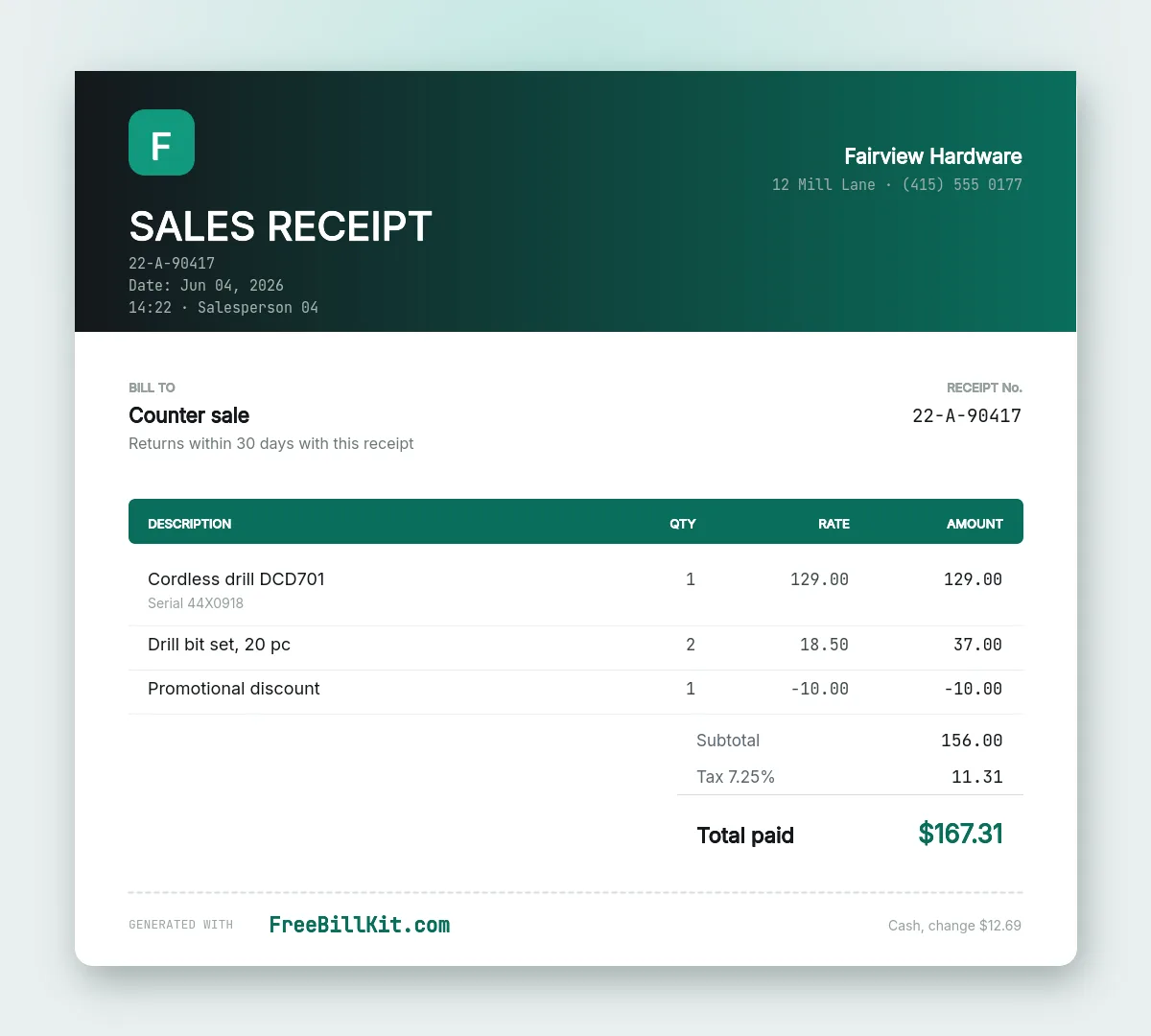
Two items sold in store on 4 June. Cordless drill, model DCD701, serial 44X0918, one at $129.00. Drill bit set, two at $18.50, line total $37.00. Subtotal $166.00, less a $10.00 promotional discount, $156.00. Tax at 7.25 percent, $11.31. Total $167.31. Paid $180.00 cash, change $12.69. Returns accepted within 30 days with this receipt, unopened.
The serial number is doing real work there. When the drill fails in month five, that line ties the tool to its purchase date for the warranty claim.
Store receipts and retail receipts
A store receipt and a sales receipt are the same document under different names. Retail is simply the setting where the sale and the payment happen at once, so one slip does both jobs. If you run a shop, use the template above and print your returns policy on it. For a supermarket or market stall, where produce is weighed and some food is tax exempt, the grocery store receipt template handles the per line tax codes properly. If you only need the card slip rather than the itemised list, use the credit card receipt template.
Sales receipt or invoice
An invoice is a request for payment, issued before the money arrives, with terms saying when it is due. A sales receipt confirms payment already made. In retail the two collapse into one moment, which is why the receipt is all that gets printed. Where a customer is buying on account, you issue the invoice first and the receipt when they settle. Issuing both for the same sale without marking the receipt against the invoice number is a reliable way to double count revenue in your books.
Make a sales receipt
Serial numbers, discounts, change given: the receipt generator has room for all of it. Fill one in at the counter and print it.
Related receipt templates
- General receipt template
- Itemized receipt template
- Gift receipt template
- Refund receipt template
- Car sale receipt template
- All free templates
Frequently asked questions
What is a purchase receipt?
A purchase receipt is proof the buyer paid for and received specific goods. Store receipts, a receipt from a shop, and a receipt for purchase all mean the same document from the buyer’s side.
What is the difference between a sales receipt and an invoice?
An invoice requests payment and carries due terms. A sales receipt confirms payment has already been made. In a shop they happen at the same moment, so only the receipt is printed.
Does a sales receipt need the buyer name?
Not always, but it helps. Warranty claims and business expense reimbursement both go more smoothly when the buyer is named, and for higher value goods it is worth recording.
Should return terms be printed on the receipt?
Yes. The return window and any conditions are far easier to enforce when they are printed on the document the customer was handed at the time of sale.